|
User Manual for Ashly 4-Channel 500W Pema Network Power Amplifier with OPDante Card & Protea DSP Software Suite Click to enlarge the picture
 Contents of the user manual for the Ashly 4-Channel 500W Pema Network Power
- Product category: 70-Volt Amplifiers Ashly
- Brand: Ashly
- Description and content of package
- Technical information and basic settings
- Frequently asked questions – FAQ
- Troubleshooting (does not switch on, does not respond, error message, what do I do if...)
- Authorized service for Ashly 70-Volt Amplifiers
|
User manual for the Ashly 4-Channel 500W Pema Network Power contain basic instructions
that need to be followed during installation and operation.
Before starting your appliance, the user manual should be read through carefully.
Follow all the safety instructions and warnings, and be guided by the given recommendations.
User manual is an integral part of any Ashly product,
and if it is sold or transferred, they should be handed over jointly with the product.
Following the instructions for use is an essential prerequisite for protecting
health and property during use, as well as recognition of liability on the part of the manufacturer
for possible defects should you make a warranty claim. Download an official Ashly user manual in which you will find instructions on how to install, use, maintain and service your product.
And do not forget – unsuitable use of a Ashly product will considerably shorten its lifespan!
|
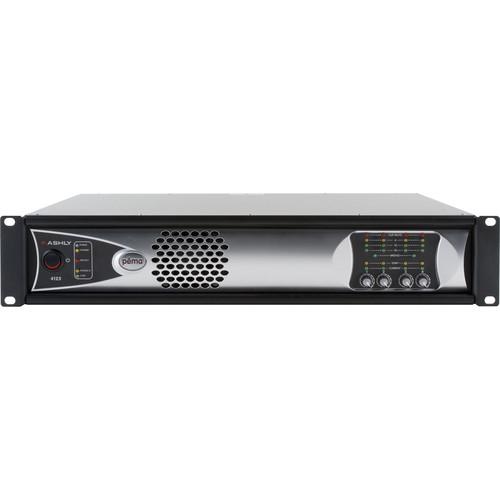
Product description The 4-Channel 500W Pema Network Power Amplifier from Ashly consists of eight inputs and four power amplifier outputs with the ability to assign any input to any output. The amplifier features pre-installed OPDante network audio interface card and the Protea DSP Software Suite. When switched into bridged-mono mode, four powered outputs deliver 75W into an 8 ohm load, 125W into an 4 ohm load, and channel pairs can be bridged for 250W into an 8 ohm load.
The power amplifier includes Euroblock input connectors and Euroblock output connectors. Besides remote standby for power up, DC remote level control, and contact closure preset recall, the amplifier also features Ethernet control, level, mute, polarity, temperature, current, and amplifier over current conditions. The front panel indicates power status, standby, protect, power switch On/Off, signal level, bridge, temperature & current levels, and Ethernet communication. A temperature dependent speed-controlled axial fan shall maintain the correct operating temperature. Full programming and control of the unit is from the rear panel RJ-45 jack connected to a 10/100BASE-T Ethernet LAN connected to a PC running the Protea Software. The amplifier mounts in a standard 19” rack using two spaces (3.5” high).
The power amplifier has an internal factory-installed Digital Signal Processing (DSP) controlled using the Protea Software Suite (network-enabled). Each amplifier input channel can be configured with pluggable DSP blocks to have its own dynamics control, gain functions, graphic and/or parametric EQ, Hi-pass/Lo-pass filters, time delay, metering, and test signal generator. Hot-plug DSP placement allows you to insert any function into any channel block, even when running live audio. A mixer section with assignable routing allows any input to drive any or all amplifier outputs. The matrix mixer also has selectable gain sharing automatic mixing capability. Outputs have the same DSP functions as inputs, with the addition of a quick and automated crossover setup. Up to 30 presets shall be standard and four presets shall be accessible via contact closure using the Protea Software Suite. - 8x8 DSP matrix with 4-channel power amplifier
- OPDante network audio interface
- Eight built-in mic preamp outputs
- Gain sharing automatic mixing capability
- Automatic feedback suppression
- Ambient noise compensation
- Dual RCA and balanced Euroblock inputs
- Post DSP Aux line level outputs
- Built-in pink/white noise & sine wave generator
- Protea DSP software suite
- 15V phantom power for mic inputs
- Full control using software over 10/100BASE-T Ethernet
- Automatic DHCP network IP configuration
- Euroblock connectors for preset recall, DC remote level control, and serial data control
- External control via standard wall remotes, Ethernet wall remotes, Remote iPad app
- Level control via variable DC control voltage
- Stand-by mode activation via contact closure
- cTUVus, CE, FCC, & RoHS safety/compliance
In the Box Ashly 4-Channel 500W Pema Network Power Amplifier with OPDante Card & Protea DSP Software Suite (Low-Z) Limited 5-Year Warranty Table of Contents
|
Upload User Manual
Have you got an user manual for the Ashly 4-Channel 500W Pema Network Power Amplifier with OPDante Card & Protea DSP Software Suite in electronic form? Please send it to us and help us expand our library of instruction manuals.
Thank you, too, on behalf of other users.
To upload the product manual, we first need to check and make sure you are not a robot. After that, your "Submit Link" or "Upload File" will appear.
Technical parametersAshly PEMA 4125D Specs | | | Frequency Response | 20 Hz to 20 kHz, +/-1 dB | | Input Sensitivity | 3.2 dBu | | Voltage Gain | 26 dB | | Damping Factor | > 250 (8 ohms load, < 1 kHz) | | Distortion | < 0.5% (SMPTE, typical)
< 0.5% (THD-N, typical, 8 Ohms, 10 dB below rated power, 20 Hz to 20 kHz | | Channel Separation | -80 dB (dB from full output, 1 kHz) | | Input Impedance | Mic/Line: 4.8 kOhms | | Maximum Input Level | Mic/Line: +21 dBu | | Gain | Preamp Mic/Line: 0, +20 dB, +40 dB, +60 dB | | Phantom Power | Mic/Line: +15 V, switchable channel 1 to 4, 5 to 8 | | Mono EQ | Summed: 3.16 kOhms (input impedance)
+11 dBu (maximum input level) | | Input | Channel 1 TEL-PBX: 3.9 kOhms (input impedance), +21 dBu (maximum input level) | | Output Level | Preamp Maximum Level: +8 dBu
Aux Maximum Level: +20 dBu | | Controls | Ethernet 10/100, Channel 1 TEL-PBX switch, Remote standby, Preset recall (4), Remote Level (8), Remote Data | | Connectors | Input/Output: Euroblock (each channel) | | Audio Connections | 1 x Euro connector balanced input, selectable for Mic, Line or TEL-PBX
7 x Euro connector balanced inputs, software selectable for Mic or Line
8 x pairs of unbalanced, summed mono RCA connectors optimized for consumer line level (-10 dBV nominal) devices
8 x Euro connector Preamp/Aux outputs
4 x Euro connector speaker outputs | | Required AC Mains | 120 VAC or 240 VAC, ±10% 50 to 60Hz | | Power Cable | Connector: 15 A Edison, 3-Prong IEC | | Signal to Noise Ratio | > 102 dB (20 Hz to 20 kHz, unweighted) | | LED Indicators | Signal Level
Red: Clip/Mute
Yellow: -6 dB
Green: -18 dB, -12 dB
Bridge: Green per channel pair
Temperature: Yellow per channel
Current: Green per channel (proportional to output) | | Output | Continuous Average Power
4 Ohms: 125 W
8 Ohms: 75 W
Bridge Mode
8 Ohms: 250 W | | Current Draw | Standby Mode: 190 mA
Idle (No Signal): 590 mA
Typical (1/8 Power Pink Noise): 1.70 A
Maximum (1/3 Power Pink Noise): 3.27 A | | Thermal Dissipation | Standby Mode: 46.7 BTU/hr
Idle (No Signal): 123 BTU/hr
Typical (1/8 Power Pink Noise): 232 BTU/hr
Maximum (1/3 Power Pink Noise): 251 BTU/hr | | Environmental | 40 to 120°F (4 to 49°C) non-condensing | | Airflow | In through sides, Out through front | | Dimensions (W x H x D) | 19 x 3.5 x 16.8" (48.3 x 8.9 x 42.6 cm) | | Weight | 23.5 lb (10.7 kg) | | | | Input Source | Input Source Select Options: Analog, Auto (Net, AES3, Analog) | | Limiter | Brick Wall Limiter
Threshold: -20 to +20 dBu
Ratio: Infinite
Attack: 0.2 to 50 ms/dB
Release: 5 to 1000 ms/dB | | Compressor | Threshold: -20 to +20 dBu
Ratio: 1.2:1 to infinite
Attack: 0.2 to 50 ms
Release: 5 to 1000 ms/dB
Detector: Peak/average
Attenuation Bus: 2 available
Metering: In, Out, Attenuation, Graphical | | Controls | Target Level: -40 to +20 dBu
Action: Gentle, normal, aggressive, user-defined
Maximum Gain: 0 to +22 dB
Metering: Input Level, Gain, Attenuation
Ratio: 1.2:1 to 10:1
Threshold Below Target: -30 to 0 dB
Gain Increase/Decrease Rate: 5 to 1000 ms/dB
Hold Time: 0 to 6 sec | | Ambient Noise Compensation | Maximum Gain: -20 to +20 dB
Minimum/Base Gain: -40 to +20 dB
Gain Change Rate: 0.2 to 20 s/dB
Link Group: 16 available>ANC Input Channel: 1-4 or 1-8
Noise Threshold: -40 to +20 dBu
Program/Ambient Gain Ratio: 0.3:1 to 3:1
Metering: Input level, Attenuation, Average noise | | Ducking | High/Low Priority, Trigger, Filibuster, Ducked Program
Trigger Threshold: -80 to +20 dBu
Ducking Release: 5 to 1000 ms/dB
Ducking Depth: 0 to -30 dB, -∞
Enable Ducking at Matrix Mixer: Yes
Metering: Input | | Gate | Threshold: -80 to +20 dBu
Range: off, 100 to 0 dB
Attack: 0.2 to 50 ms/dB
Release: 5 to 1000 ms/dB
Metering: Key Signal, Gate LED, Graphical
Advanced Gate Controls
Key Engage Enable: Yes
Key Frequency: 20 Hz to 20 kHz
Key Bandwidth: 0.016 to 3.995 octave | | Gain | Gain (with/without VCA): -50 to +12 dB, off, polarity invert
Digital VCA Groups: 4 available
Remote RD8C Gain: Enable per channel, 0 dB to -∞
WR-5 (neWR-5) Remote Gain: 0 to -50 dB, mute | | EQ Controls | FIR Filter
File Type: .csv, .fir
31-Band
Filter Type: Constant Q or proportional Q
Bandwidth: 0.499 to 0.25 oct
Parametric 2,4,6, or 10 Band
Frequency: 20 to 20 kHz
Level: -30 to +15 dB
Q Value: 0.016 to 3.995 Octave
Hi/Low Shelf 6/12 dB/oct
Frequency: 20 Hz to 20 kHz
Level: -15 to +15 dB
All Pass
Frequency: 20 Hz to 20 kHz
Variable Q HP/LP
Frequency: 20 Hz to 20 kHz
Q Value: 3.047 to 0.267
Notch/Bandpass
Frequency: 20 Hz to 20 kHz
Q Value: 92.436 to 0.267 | | Feedback | Feedback Suppressor: Only available w/ 48 kHz sampling rate (inputs only)
Filters: 12
In/Out per filter: Yes
Filter Modes: Float, Restricted, Manual
Filter Type: Notch, Parametric
Filter Frequency Range: 20 Hz to 20 kHz
Parametric Filter Level: +15 to -30 dB
Filter Bandwidth: 0.016 to 3.995 Octave
Detector Sensitivity: 5 levels
Float Time: 5 minutes to 24 hours | | Crossover | 2 Way, 3 Way, 4 Way Crossover & High-Pass/Low-Pass Filters
Bessel & Butterworth Filters: 12/18/24/48 dB/oct
Linkwitz-Riley Filter: 12/24/48 dB/oct
Frequency:Off, 20 Hz to 20 kHz | | Delay | @ 48 kHz Sampling Rate (Input Time, Distance & Temperature)
Speaker Delay: 0 to 21 ms
Delay: 0 to 682 ms
@ 96 kHz Sampling Rate (Input Time, Distance & Temperature)
Speaker Delay: 0 to 10.6 ms
Delay: 0 to 341 ms | | Audio Metering | Range: -60 to +20 dBu
Increments: 1 dB
Peak Hold Indicator: Yes | | Signal Generator | Pink noise, White noise, Sine wave
Signal Level: Off, -50 to +20 dBu
Sine Wave Frequency: 20 Hz to 12 kHz | | Mixer | Gain (0.5 dB increments): Off, -50 to +12 dB
Mute: Per channel
Auto-Mixer: Per channel
Global Auto-mixer Response: 0.01 to 2 sec
Enable Ducking at Mixer: Yes
Ducking LED: Per channel if enabled
Metering: Level, auto-mixer level | | Processors | Input A/D, Output D/A: 24-bit
DSP Processors: 32-bit floating point
Sample Rates: 48 and 96 kHz
Propagation Delay: 1.42 ms @ 48 kHz & 1.71 ms @ 96 kHz |
Rating70% users recommend this product to others. And what about you?

This product has already been rated by 91 owners. Add your rating and experience with the product.
Discussion
 Ask our technicians if you have a problem with your settings,
or if anything is unclear in the user manual you have downloaded.
You can make use of our moderated discussion.
The discussion is public and helps other users of our website who may be encountering similar problems.
Ask our technicians if you have a problem with your settings,
or if anything is unclear in the user manual you have downloaded.
You can make use of our moderated discussion.
The discussion is public and helps other users of our website who may be encountering similar problems.
The discussion is empty - enter the first post
Post a new topic / query / comment:
|
|
|
| Request for user manual |
You can’t find the operation manual you are looking for? Let us know and we will try to add the missing manual:
I’m looking for a manual / Request for manual
Current requests for instruction manuals:
Call Of Duty World War Two For Xbox...
controller stratus XL...
stratus XL...
smart whatch serie S11 42mm...
Allen & Heath SQ-6 manual...
|
| Discussion |
Latest contributions to the discussion:
AEW R 4100
Name: MAURICIO ANGARITA
Audio-Technica AEW-R4100 UHF Diversity Receiver for
AEW R 4100 has the mute function blocked and does not allow audio to pass. I tried several times to turn off the mute from the transmitter but it does nothing, the mute stays on. Solution?
Thank you...
Instructions for assembling the 2015 Forecast Image Master Consoles GC3-A
Name: mike elam
Forecast Consoles GC3-A ImageMaster Editing Console
Looking for instructions for assembling this console. ...
EMPTY TONER ERROR MESSAGE AFTER REPLACING TONER
Name: LINDA BAD YELLOW EYES
Brother TN223BK Standard-Yield Toner
I HAD TO CHANGE OUT ALL THREE TONERS DUE TO LEAKS IN THE YELLOW AND CYAN. AFTER I REPLACED THEM, THE MACHINE KEEPS GIVING ME AN EMPTY TONER ERROR MESSAGE. HELP!!...
PS480D 20/24 pin Switching 480W Power Supply
Name: swkargo
Logisys 480W Power Supply
This item states in can run -5vdc .It is NOT listed on the board or I beleive is r4 is missing the resitior. Any body have thid issue. Shawn
...
Help needed
Name: Ann Carter
SanDisk 1TB Extreme Portable USB 3.1
When I click the link to download the user manual for my Sandisk Extreme external hard drive, it gives me the manual for the LG Cricket. Can you please change the link so I can download the Sandisk manual and begin using this drive? Thank you....
|
|