User Manual for Ashly 8-Channel 2000W Network-Enabled Power Amplifier with AES3, CobraNet, & Protea DSP Software Suite Click to enlarge the picture
 Contents of the user manual for the Ashly 8-Channel 2000W Network-Enabled Power Amplifier
- Product category: 70-Volt Amplifiers Ashly
- Brand: Ashly
- Description and content of package
- Technical information and basic settings
- Frequently asked questions – FAQ
- Troubleshooting (does not switch on, does not respond, error message, what do I do if...)
- Authorized service for Ashly 70-Volt Amplifiers
|
User manual for the Ashly 8-Channel 2000W Network-Enabled Power Amplifier contain basic instructions
that need to be followed during installation and operation.
Before starting your appliance, the user manual should be read through carefully.
Follow all the safety instructions and warnings, and be guided by the given recommendations.
User manual is an integral part of any Ashly product,
and if it is sold or transferred, they should be handed over jointly with the product.
Following the instructions for use is an essential prerequisite for protecting
health and property during use, as well as recognition of liability on the part of the manufacturer
for possible defects should you make a warranty claim. Download an official Ashly user manual in which you will find instructions on how to install, use, maintain and service your product.
And do not forget – unsuitable use of a Ashly product will considerably shorten its lifespan!
|
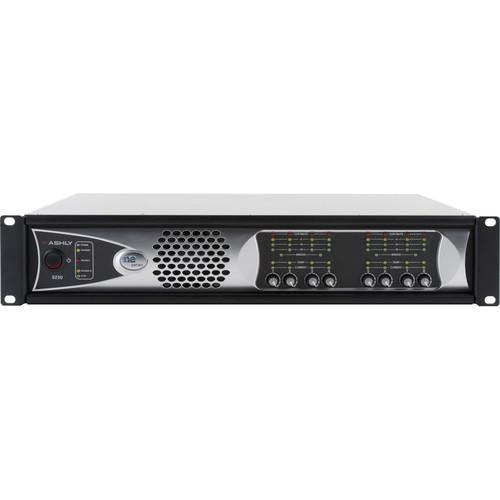
Product description The 8-Channel 2000W Network-Enabled Power Amplifier from Ashly delivers a minimum power of 250W RMS power per channel into 70V loads with all channels operating. The amplifier features pre-installed AES3 input card with pass-thru, CobraNet, and the Protea DSP Software Suite; and is designed around an energy efficient Class-D platform with a switching power supply. When switched into bridged-mono mode, channels 1+2 or 3+4 or 5+6 or 7+8 of the amplifier delivers over 500W RMS into an 140V load.The power amplifier includes Euroblock input connectors, Euroblock output connectors, and balanced analog inputs. Besides remote standby for power up, DC remote level control, and contact closure preset recall, the amplifier also features Ethernet control & monitoring of power functions, level, mute, polarity, temperature, current, and amplifier fault conditions. The front panel indicates power status, standby, protect, power switch On/Off, signal level, bridge, temperature & current levels, and Ethernet communication. The amplifier mounts in a standard 19” rack using two spaces (3.5” high).The power amplifier has an internal factory-installed Digital Signal Processing (DSP) controlled using the Protea Software Suite (network-enabled). Each amplifier input channel can be configured with pluggable DSP blocks to have its own dynamics control, gain functions, graphic and/or parametric EQ, Hi-pass/Lo-pass filters, time delay, metering, and test signal generator. A mixer section with assignable routing allows any input to drive any or all amplifier outputs.Outputs have the same DSP functions as inputs, with the addition of a quick and automated crossover setup. Both inputs and outputs duplicate their settings to other channels, or link with one or more other channels to track their settings. Presets can be used to store and retrieve global parameters of an amplifier’s control surface and DSP section from a file. Sub-presets allows for a collection of individual DSP function parameters within and across both channels of an amplifier to be stored and recalled as a set, affecting only those parameters which have been tagged. Up to 35 presets/sub-presets can be stored within the amplifier and recalled in real time via Ethernet from a computer using the Protea Software Suite. -
- 10/100 Ethernet for remote control and monitoring
- 70V constant voltage
- Pre-installed CobraNet card, AES3 input card with pass-thru, and Protea DSP Software Suite
- DC voltage remote gain control
- Switched-mode power supply, Class-D output
- Stepped & calibrated input attenuators
- Remote power standby
- All front panel controls can be disabled via software
- Temperature-sensitive variable speed fan with front-to-back airflow
- Selectable HPF frequencies (80 Hz, 400 Hz, off)
- 4-stage level meters
- Output current and temperature indicators
- cTUVus, CE, FCC, and RoHS safety/compliance
In the Box Ashly 8-Channel 2000W Network-Enabled Power Amplifier with AES3, CobraNet, & Protea DSP Software Suite (70V) Limited 5-Year Warranty Table of Contents
|
Upload User Manual
Have you got an user manual for the Ashly 8-Channel 2000W Network-Enabled Power Amplifier with AES3, CobraNet, & Protea DSP Software Suite in electronic form? Please send it to us and help us expand our library of instruction manuals.
Thank you, too, on behalf of other users.
To upload the product manual, we first need to check and make sure you are not a robot. After that, your "Submit Link" or "Upload File" will appear.
Technical parametersAshly NE8250.70PEAC Specs | | | Frequency Response | 20 Hz to 20 kHz, (unweighted) ± 1 dB | | Input Impedance | 20 kOhms, balanced | | Voltage Gain | 32 dB | | Input Sensitivity | 7.2 dBu | | Maximum Input Level | +21 dBu | | Software Control | 80 Hz (12 dB/oct), 400 Hz (6 dB/oct), Off | | Distortion | 8 Ohms load:
< 0.5 % typical (SMPTE)
< 0.5 % typical (20 Hz to 20 kHz) (THD-N) | | Damping Factor | > 250 (8 Ohms, 1 kHz) | | Circuitry | Class D | | Maximum load protection | Output Overcurrent, Main Supply Rail Overvoltage, Chassis Temperature, Inrush Limiting, Mains Fuse | | Controls | Remote standby, Preset recall (4), Remote Level (8), Remote Data | | Connectors | Input/Output: Euroblock (each channel) | | Required AC Mains | 120 VAC or 240 VAC, ±10% 50 to 60 Hz | | Cable Connectors | 15 A Edison, 3-Prong IEC | | Signal to Noise Ratio | > 107 dB (20 Hz to 20 kHz, unweighted) | | LED Indicators | Signal Level
Red: Clip
Yellow: -6 dB
Green: -18 dB, -12 dB
Bridge: Green per channel pair
Temperature: Yellow per channel
Current: Green per channel (proportional to output) | | Output | 250 W per channel | | Current Draw | Standby Mode: 290 mA
Idle (No Signal): 565 mA
Typical (1/8 Power Pink Noise): 5.00 A
Maximum (1/3 Power Pink Noise): 11.0 A | | Thermal Dissipation | Standby Mode: 63.8 BTU/hr
Idle (No Signal): 187 BTU/hr
Typical (1/8 Power Pink Noise): 700 BTU/hr
Maximum (1/3 Power Pink Noise): 775 BTU/hr | | Dimensions (W x H x D) | 19 x 3.5 x 16" (48 x 8.9 x 41 cm) | | Weight | 20 lb (9.1 kg) | | | | Input Source | Input Source Select Options: Analog, Auto (Net, AES3, Analog) | | Limiter | Brick Wall Limiter
Threshold: -20 to +20 dBu
Ratio: Infinite
Attack: 0.2 to 50 ms/dB
Release: 5 to 1000 ms/dB | | Compressor | Threshold: -20 to +20 dBu
Ratio: 1.2:1 to infinite
Attack: 0.2 to 50 ms
Release: 5 to 1000 ms/dB
Detector: Peak/average
Attenuation Bus: 4 available
Metering: In, Out, Attenuation, Graphical | | Controls | Target Level: -40 to +20 dBu
Action: Gentle, normal, aggressive, user-defined
Maximum Gain: 0 to +22 dB
Metering: Input Level, Gain, Attenuation
Ratio: 1.2:1 to 10:1
Threshold Below Target: -30 to 0 dB
Gain Increase/Decrease Rate: 5 to 1000 ms/dB
Hold Time: 0 to 6 sec | | Ducking | High/Low Priority, Trigger, Filibuster, Ducked Program
Trigger Threshold: -80 to +20 dBu
Ducking Release: 5 to 1000 ms/dB
Ducking Depth: 0 to -30 dB, -∞
Enable Ducking at Matrix Mixer: Yes
Metering: Input | | Gate | Threshold: -80 to +20 dBu
Range: off, 100 to 0 dB
Attack: 0.2 to 50 ms/dB
Release: 5 to 1000 ms/dB
Metering: Key Signal, Gate LED, Graphical
Advanced Gate Controls
Key Engage Enable: Yes
Key Frequency: 20 Hz to 20 kHz
Key Bandwidth: 0.016 to 3.995 octave | | Gain | Gain (with/without VCA): -50 to +12 dB, off, polarity invert
Digital VCA Groups: 4 available
Remote RD8C Gain: Enable per channel, 0 dB to -∞
WR-5 (neWR-5) Remote Gain: 0 to -50 dB, mute | | EQ Controls | 31-Band
Filter Type: Constant Q or proportional Q
Bandwidth: 0.499 to 0.25 oct
Parametric 2,4,6, or 10 Band
Frequency: 20 to 20 kHz
Level: -30 to +15 dB
Q Value: 0.016 to 3.995 Octave
Hi/Low Shelf 6/12 dB/oct
Frequency: 20 Hz to 20 kHz
Level: -15 to +15 dB
All Pass
Frequency: 20 Hz to 20 kHz
Variable Q HP/LP
Frequency: 20 Hz to 20 kHz
Q Value: 3.047 to 0.267
Notch/Bandpass
Frequency: 20 Hz to 20 kHz
Bandwidth Range: 0.016 to 3.995 oct. | | Crossover | 2 Way, 3 Way, 4 Way Crossover & High-Pass/Low-Pass Filters
Bessel & Butterworth Filters: 12/18/24/48 dB/oct
Linkwitz-Riley Filter: 12/24/48 dB/oct
Notched Linkwitz-Riley: 4th Order, 8th Order
Frequency:Off, 20 Hz to 20 kHz | | Delay | @ 48 kHz Sampling Rate (Input Time, Distance & Temperature)
Speaker Delay: 0 to 58.65 ms
Delay: 0 to 1.365.31 ms
@ 96 kHz Sampling Rate (Input Time, Distance & Temperature)
Speaker Delay: 0 to 29.32 ms
Delay: 0 to 682.65 ms | | Audio Metering | Range: -60 to +20 dBu
Increments: 1 dB
Peak Hold Indicator: Yes | | Signal Generator | Pink noise, White noise, Sine wave
Signal Level: Off, -50 to +20 dBu
Sine Wave Frequency: 20 Hz to 12 kHz | | Mixer | Gain (0.5 dB increments): Off, -50 to +12 dB
Mute: Input
Auto-Mixer: Automix assign per input
Global Auto-mixer Response: 0.01 to 2 sec
Enable Ducking at Mixer: Yes
Ducking LED: Per channel if enabled
Metering: Level, auto-mixer level | | Processors | Input A/D, Output D/A: 24 bit
DSP Processors: 32-bit floating point
Sample Rates: 48 and 96 kHz |
Rating70% users recommend this product to others. And what about you?

This product has already been rated by 18 owners. Add your rating and experience with the product.
Discussion
 Ask our technicians if you have a problem with your settings,
or if anything is unclear in the user manual you have downloaded.
You can make use of our moderated discussion.
The discussion is public and helps other users of our website who may be encountering similar problems.
Ask our technicians if you have a problem with your settings,
or if anything is unclear in the user manual you have downloaded.
You can make use of our moderated discussion.
The discussion is public and helps other users of our website who may be encountering similar problems.
The discussion is empty - enter the first post
Post a new topic / query / comment:
|
|