|
User Manual for Eventide Eclipse V4 Multi-Effects Processor Click to enlarge the picture
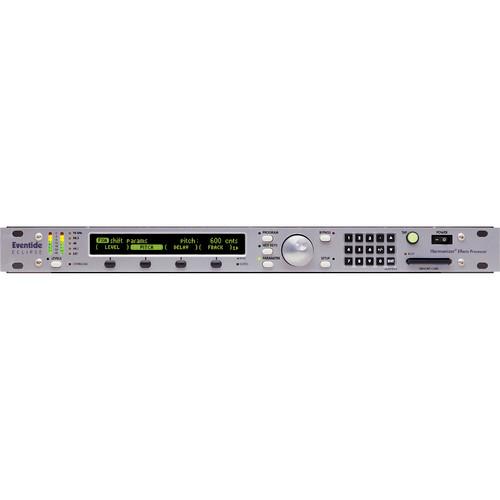 Contents of the user manual for the Eventide Eclipse V4 Multi-Effects Processor
- Product category: Effects Processors Eventide
- Brand: Eventide
- Description and content of package
- Technical information and basic settings
- Frequently asked questions – FAQ
- Troubleshooting (does not switch on, does not respond, error message, what do I do if...)
- Authorized service for Eventide Effects Processors
|
User manual for the Eventide Eclipse V4 Multi-Effects Processor contain basic instructions
that need to be followed during installation and operation.
Before starting your appliance, the user manual should be read through carefully.
Follow all the safety instructions and warnings, and be guided by the given recommendations.
User manual is an integral part of any Eventide product,
and if it is sold or transferred, they should be handed over jointly with the product.
Following the instructions for use is an essential prerequisite for protecting
health and property during use, as well as recognition of liability on the part of the manufacturer
for possible defects should you make a warranty claim. Download an official Eventide user manual in which you will find instructions on how to install, use, maintain and service your product.
And do not forget – unsuitable use of a Eventide product will considerably shorten its lifespan!
|
Product description The Eclipse V4 from Eventide is a compact multi-effects processor that offers a wide range of depth of its algorithms. Eventide has provided almost 100 algorithms in the Eclipse, any of which can be routed to the two independent effects blocks and then outputted in stereo or mono. It can process audio at 24-bit and handle 96-kHz sampling rates. Digitally, the Eclipse accommodates AES/EBU, S/PDIF, and ADAT Lightpipe. For analog, the Eclipse features balanced XLR and unbalanced 1/4" inputs and outputs. The 1/4" jacks allows for high impedance instrument signals. The processor additionally includes word clock I/O, an external power jack, MIDI in/out/thru, and two pedal ports for live performance triggering.
The Eclipse boasts 11 reverberation algorithms and four plex algorithms, all of which are true stereo in and out. This effects processor additionally offers Micro pitch shift technology for improving vocal tuning. With the Eclipse, you get an array of delays, 20 seconds of mono looping, and 10 seconds of stereo looping, which can all be combined using the two independent effects blocks.
The Eclipse's user interface is designed to be intuitive and easy to operate. The layout of the knobs and keypad are similar to the H3000 Harmonizer unit's, but with the addition of hot keys to help speed up the tweaking process of the presets. A dedicated tap button can affect the delay timings, LFOs, autopanner speed, or tremolo, enabling you to easily lock into a live performance tempo. You can make your own presets and save them to a compact flash card or the internal memory. Once your presets are saved, the compact flash cards allow you to easily transfer your data from one Eclipse to another, if needed. - Dual Effects Block Architecture
- The Eclipse features two configurable effects blocks which can be set to serial, parallel, or dual-mono, allowing you to use two independent effects at the same time in mono or stereo. The Eclipse comes equipped with almost 100 algorithms and features 24-bit conversion and 96-kHz sampling.
- Eventide Effects
- The Eclipse features many Eventide effects, including Micro pitch shift for vocal tuning, 11 reverberation algorithms, four plex algorithms developed for the DSP 7000 series, multiple delay types, 20-second mono looping, and 10-second stereo looping. All the reverbs are true stereo, and there is a vast array of delays. Run a 20-second loop on one FX block and use the other FX block for ambiance.
- I/O Ports for Versatility
- The Eclipse features AES/EBU, S/PDIF, and ADAT Lightpipe for digital applications. Analog connections include balanced XLR, unbalanced 1/4" ins and outs, high impedance 1/4", word clock in and out on BNC connectors, MIDI in and out, and two pedal ports for live performances. The Eclipse comes with an external power jack input and a serial port, which allows you to update the firmware through your home computer.
- Easy Setup and Operation
- The Eclipse knob and keypad layout makes setup and operation easy, especially for those familiar with the H3000 Harmonizer.
- Hot Keys
- The hot keys provide quick access to the eight most important parameters of each preset. You can also save custom hot key mappings in your own presets.
- Dedicated Tap Button
- The tap button can control delay timing, LFO modulation, autopanner speed, and tremolo speed. You can also set the tap function range to average from two to twelve taps.
- Design Your Own Preset
- Choose one or two algorithms, pick a routing, apply hot keys, and fine tune the parameters until it fits your needs.
- Flash Card Slot
- Your presets can be stored in the Eclipse memory or on an external compact flash card. You can then transfer presets between internal memory and your flash card.
UPC: 840694000081 In the Box Eventide Eclipse V4 Multi-Effects Processor Power Cord Mounting Kit Limited 1 Year Warranty Table of Contents
|
Upload User Manual
Have you got an user manual for the Eventide Eclipse V4 Multi-Effects Processor in electronic form? Please send it to us and help us expand our library of instruction manuals.
Thank you, too, on behalf of other users.
To upload the product manual, we first need to check and make sure you are not a robot. After that, your "Submit Link" or "Upload File" will appear.
Technical parametersEventide Eclipse V4 Specs | Sample Rates | 96 kHz
88.2 kHz
48 kHz
44.1 kHz
Word Clock
AES
S/PDIF
ADAT | | Digital Input/Output | 2 Channels of AES/EBU, S/PDIF (optical / coaxial), or ADAT Lightpipe | | Analog Input | Impedance: 20 kOhms
Full Scale Input Level: 26 dBu
Dynamic Range: >104 dB
Signal-to-Noise Ratio: >104 dB
THD+N: <0.003 @ 1 kHz, -3 dBFS
Crosstalk: <-100 db @ 20 hz to khz, -1 dbfs
Frequency Response: +0 / -0.1 dB @ sample rate:
44.1 kHz: 20 Hz to 20 kHz
48 kHz: 20 Hz to 22 kHz
88.2 kHz: 20 Hz to 41 kHz
96 kHz: 20 Hz to 44 kHz | | Analog Output | Impedance: < 50 ohms
Full Scale Input Level: 26 dBu
Dynamic Range: >108 dB
Signal-to-Noise Ratio: >108 dB
THD+N: <0.003 @ 1 kHz, -3 dBFS
Crosstalk: <-100 db @ 20 hz to khz, -1 dbfs
Frequency Response: +0 / -0.1 dB @ sample rate:
44.1 kHz: 10 Hz to 20 kHz
48 kHz: 10 Hz to 22 kHz
88.2 kHz: 10 Hz to 41 kHz
96 kHz: 10 Hz to 44 kHz | | Other I/O Connections | Remote Control Inputs: Up to 2 foot pedals (or 5V control inputs) or 6 foot switches (or combination)
MIDI Connections: 5-pin DIN output and thru, 7-pin DIN input with output capability and external power jack
Compact Flash Interface: Supports Type I and Type II compact flash cards for data storage | | Power Supply | 40 W, 100 to 240 VAC, 50 to 60 Hz | | Dimensions | 1.75 x 19.00 x 10.50" / 4.5 x 48.3 x 26.7 cm | | Weight | 9 lb / 4.1 kg | | | | Package Weight | 12.0 lb | | Box Dimensions (LxWxH) | 22.0 x 12.7 x 8.2" |
Rating90% users recommend this product to others. And what about you?

This product has already been rated by 03 owners. Add your rating and experience with the product.
Discussion
 Ask our technicians if you have a problem with your settings,
or if anything is unclear in the user manual you have downloaded.
You can make use of our moderated discussion.
The discussion is public and helps other users of our website who may be encountering similar problems.
Ask our technicians if you have a problem with your settings,
or if anything is unclear in the user manual you have downloaded.
You can make use of our moderated discussion.
The discussion is public and helps other users of our website who may be encountering similar problems.
The discussion is empty - enter the first post
Post a new topic / query / comment:
|
|
|
| Request for user manual |
You can’t find the operation manual you are looking for? Let us know and we will try to add the missing manual:
I’m looking for a manual / Request for manual
Current requests for instruction manuals:
Call Of Duty World War Two For Xbox...
controller stratus XL...
stratus XL...
smart whatch serie S11 42mm...
Allen & Heath SQ-6 manual...
|
| Discussion |
Latest contributions to the discussion:
AEW R 4100
Name: MAURICIO ANGARITA
Audio-Technica AEW-R4100 UHF Diversity Receiver for
AEW R 4100 has the mute function blocked and does not allow audio to pass. I tried several times to turn off the mute from the transmitter but it does nothing, the mute stays on. Solution?
Thank you...
Instructions for assembling the 2015 Forecast Image Master Consoles GC3-A
Name: mike elam
Forecast Consoles GC3-A ImageMaster Editing Console
Looking for instructions for assembling this console. ...
EMPTY TONER ERROR MESSAGE AFTER REPLACING TONER
Name: LINDA BAD YELLOW EYES
Brother TN223BK Standard-Yield Toner
I HAD TO CHANGE OUT ALL THREE TONERS DUE TO LEAKS IN THE YELLOW AND CYAN. AFTER I REPLACED THEM, THE MACHINE KEEPS GIVING ME AN EMPTY TONER ERROR MESSAGE. HELP!!...
PS480D 20/24 pin Switching 480W Power Supply
Name: swkargo
Logisys 480W Power Supply
This item states in can run -5vdc .It is NOT listed on the board or I beleive is r4 is missing the resitior. Any body have thid issue. Shawn
...
Help needed
Name: Ann Carter
SanDisk 1TB Extreme Portable USB 3.1
When I click the link to download the user manual for my Sandisk Extreme external hard drive, it gives me the manual for the LG Cricket. Can you please change the link so I can download the Sandisk manual and begin using this drive? Thank you....
|
|