|
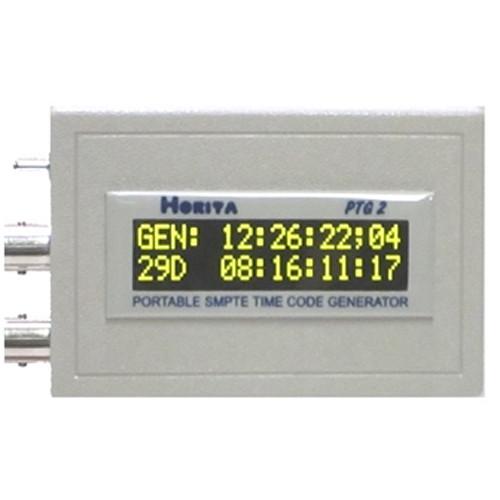
User Manual for Horita PTG2 Portable Timecode Generator with 2 Line OLED Display Click to enlarge the picture
 Contents of the user manual for the Horita PTG2 Portable Timecode Generator with
- Product category: Time Code Generators & Readers Horita
- Brand: Horita
- Description and content of package
- Technical information and basic settings
- Frequently asked questions – FAQ
- Troubleshooting (does not switch on, does not respond, error message, what do I do if...)
- Authorized service for Horita Time Code Generators & Readers
|
User manual for the Horita PTG2 Portable Timecode Generator with contain basic instructions
that need to be followed during installation and operation.
Before starting your appliance, the user manual should be read through carefully.
Follow all the safety instructions and warnings, and be guided by the given recommendations.
User manual is an integral part of any Horita product,
and if it is sold or transferred, they should be handed over jointly with the product.
Following the instructions for use is an essential prerequisite for protecting
health and property during use, as well as recognition of liability on the part of the manufacturer
for possible defects should you make a warranty claim. Download an official Horita user manual in which you will find instructions on how to install, use, maintain and service your product.
And do not forget – unsuitable use of a Horita product will considerably shorten its lifespan!
|
Product description The PTG2 from Horita is a palm-sized SMPTE timecode generator/reader that is simple to setup and operate and features a large, 2-line OLED display readout for timecode, user bits, and setup information. It is an ideal generator for use with video recorders in multi-camera situations where it is necessary for each recording to have the same timecode for precise time and image matching during post production. These situations may include sporting events, games, concerts, automobile, aircraft, and boating events, parades, weddings, and more.For these applications, individual timecode generators/readers are jammed (automatically preset and started) via an externally applied SMPTE timecode signal. The generator's time value is set to the input timecode time value and the timecode user bits are set to the date plus a unique ID number for each individual PTG2. Each recording will then have the same time and date but a different ID number so the recordings cannot get mixed up later. The PTG2 can also jam to the GPS time and date from an RS-232 serial data input from a GPS receiver for generation of precise worldwide UTC time of day and date timecode. - Reads and generates SMPTE timecode for frame rates of 23.976, 24, 25, 29.97 drop/non-drop frame, and 30 fps (frames-per-second), plus the HD frame rates for 50/720p, 50/1080i, 59.94/720p, and 59.94/1080i
- Provides selection of LINE or MIC output level when generating timecode and includes various common MIC/ LINE adapter connectors
- Timecode generator jam mode presets the generator to TC or GPS serial data input values for time and date
- Prevents accidentally stopping the generator via unintended actuation of the "run/stop" switch
- Low free-run drift rate of less than one frame per hour over temperature
- Able to genlock to an externally applied SD NTSC RS-170A or a PAL 625/50 analog composite video reference signal (bi-level) or to a tri-level reference signal for the HD frame rates
- Timecode reader mode displays timecode, user bits, and frame rate values when reading timecode or GPS time and date values when reading GPS data
- All settings and presets are maintained in non-volatile memory, even when the battery is removed
- Operates in display power save mode for over 17 hours on a single 9V alkaline battery
In the Box Horita PTG2 Portable Timecode Generator with 2 Line OLED Display RCA-3.5mm Phone Adapter RCA-BNC Adapter 8" RCA-RCA Cable Limited 3-Year Warranty Table of Contents
|
Upload User Manual
Have you got an user manual for the Horita PTG2 Portable Timecode Generator with 2 Line OLED Display in electronic form? Please send it to us and help us expand our library of instruction manuals.
Thank you, too, on behalf of other users.
To upload the product manual, we first need to check and make sure you are not a robot. After that, your "Submit Link" or "Upload File" will appear.
Technical parametersHorita PTG 2 Specs | Battery | 9 V, NEDA/ANSI 1604 A | | Switches | Power: Momentary ON-OFF-ON toggle switch
LED: Red, indicates power ON and flashes when reading or generating timecode
LCD: Displays 2 lines of 16 characters each | | Time Code | Format: SMPTE timecode format running at frame rates of 23.976, 24, 25, 29.97DF, 29.97/30 NDF, or 30 fps
Input Level: 0.5 to 10 V p-p (-20 dBV to +8 dBu)
Impedance: 10 kOhms approximately
Output Level: LINE level approximately 2.5 V p-p (-2 dBV/0.22 dBu) square wave, MIC level approximately -35 dBV/-33 dBu (50 mV p-p) square wave, 10K load, approximately -38 dBV/-36 dBu (35 mV P-P) square wave, 1K load
Connector: RCA
Generator Drift: Not more than +/-1-frame per hour over temperature range | | GPS | Input Level: RS-232
Format: NMEA $GPGGA, $GPRMC, or $GPZDA
Baud/Bits: 4800, 8 bits, no parity | | Video | Input Level: RS170A composite NTSC video or equivalent 625/50 PAL video, 0.5 to 2 V p-p Not terminated by PTG. | | Environment | Operating: 41 to 104°F (5 to 40°C)
Storage: 14 to 140°F (-10 to 60°C) | | Dimensions | 1 x 2.4 x 4.75" (2.5 x 6.1 x 12.1 cm) | | Weight | 5 oz (142 g), including battery | | | | Package Weight | 0.82 lb | | Box Dimensions (LxWxH) | 6.85 x 6.45 x 3.25" |
Rating100% users recommend this product to others. And what about you?

This product has already been rated by 45 owners. Add your rating and experience with the product.
Discussion
 Ask our technicians if you have a problem with your settings,
or if anything is unclear in the user manual you have downloaded.
You can make use of our moderated discussion.
The discussion is public and helps other users of our website who may be encountering similar problems.
Ask our technicians if you have a problem with your settings,
or if anything is unclear in the user manual you have downloaded.
You can make use of our moderated discussion.
The discussion is public and helps other users of our website who may be encountering similar problems.
The discussion is empty - enter the first post
Post a new topic / query / comment:
|
|
|
| Request for user manual |
You can’t find the operation manual you are looking for? Let us know and we will try to add the missing manual:
I’m looking for a manual / Request for manual
Current requests for instruction manuals:
Call Of Duty World War Two For Xbox...
controller stratus XL...
stratus XL...
smart whatch serie S11 42mm...
Allen & Heath SQ-6 manual...
|
| Discussion |
Latest contributions to the discussion:
AEW R 4100
Name: MAURICIO ANGARITA
Audio-Technica AEW-R4100 UHF Diversity Receiver for
AEW R 4100 has the mute function blocked and does not allow audio to pass. I tried several times to turn off the mute from the transmitter but it does nothing, the mute stays on. Solution?
Thank you...
Instructions for assembling the 2015 Forecast Image Master Consoles GC3-A
Name: mike elam
Forecast Consoles GC3-A ImageMaster Editing Console
Looking for instructions for assembling this console. ...
EMPTY TONER ERROR MESSAGE AFTER REPLACING TONER
Name: LINDA BAD YELLOW EYES
Brother TN223BK Standard-Yield Toner
I HAD TO CHANGE OUT ALL THREE TONERS DUE TO LEAKS IN THE YELLOW AND CYAN. AFTER I REPLACED THEM, THE MACHINE KEEPS GIVING ME AN EMPTY TONER ERROR MESSAGE. HELP!!...
PS480D 20/24 pin Switching 480W Power Supply
Name: swkargo
Logisys 480W Power Supply
This item states in can run -5vdc .It is NOT listed on the board or I beleive is r4 is missing the resitior. Any body have thid issue. Shawn
...
Help needed
Name: Ann Carter
SanDisk 1TB Extreme Portable USB 3.1
When I click the link to download the user manual for my Sandisk Extreme external hard drive, it gives me the manual for the LG Cricket. Can you please change the link so I can download the Sandisk manual and begin using this drive? Thank you....
|
|