|
User Manual for Meade Series 4000 #3200 Lunar And Planetary Color Filter Set Click to enlarge the picture
 Contents of the user manual for the Meade Series 4000 #3200 Lunar And
- Product category: Eyepiece Filters Meade
- Brand: Meade
- Description and content of package
- Technical information and basic settings
- Frequently asked questions – FAQ
- Troubleshooting (does not switch on, does not respond, error message, what do I do if...)
- Authorized service for Meade Eyepiece Filters
|
User manual for the Meade Series 4000 #3200 Lunar And contain basic instructions
that need to be followed during installation and operation.
Before starting your appliance, the user manual should be read through carefully.
Follow all the safety instructions and warnings, and be guided by the given recommendations.
User manual is an integral part of any Meade product,
and if it is sold or transferred, they should be handed over jointly with the product.
Following the instructions for use is an essential prerequisite for protecting
health and property during use, as well as recognition of liability on the part of the manufacturer
for possible defects should you make a warranty claim. Download an official Meade user manual in which you will find instructions on how to install, use, maintain and service your product.
And do not forget – unsuitable use of a Meade product will considerably shorten its lifespan!
|
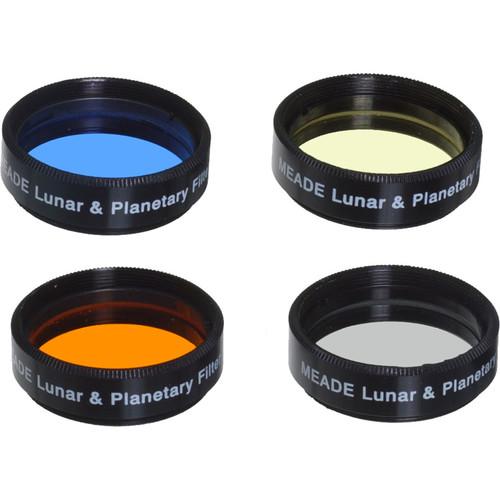
Product description The 1.25" Series 4000 #3200 Lunar And Planetary Color Filter Set from Meade Instruments comes with four assorted filters mounted in black anodized aluminum cells, packed in a plastic case. All four eyepiece filters are threaded to fit most 1.25" eyepieces and accessories. The cells of each filter are double-threaded so that they can be stacked in different combinations. This filter set includes: ND-96 Neutral Density, #12 Yellow, #25A Red, and #80A Blue filters. - #25A Red Filter
-
- 14% transmission
- Moon: Improves lunar features
- Jupiter: Useful for studying bluer clouds
- Mars: Ideal for observation of the polar ice caps and features on the Martian surface. Sharpens the boundaries of yellow dust clouds
- Mercury: Improves observation at twilight, when the planet is near the horizon. During daylight, it reduces the brightness of the blue sky to enhance surface features
- Saturn: Useful for studying bluer clouds
- Venus: Use during daylight observing to reduce brightness of blue sky. Occasionally deformations of the terminator are visible
- #80A Blue Filter
-
- 30% transmission
- Moon: Enhances lunar detail
- Jupiter: Enhance the boundaries between the reddish belts and adjacent bright zones. Useful for viewing the Great Red Spot
- Mars: Very useful during the violet clearing. Helpful in studying surface features and polar caps
- Mercury: Improve observation of dusky surface markings at twilight, when the planet is near the horizon
- Saturn: Enhance low-contrast features between the belts and zones
- Venus: Useful for increased contrast of dark shadings in upper Venusian clouds
- Comets: Brings out the best definition in comet gas tails
- #12 Yellow
-
- 74% transmission
- Moon - Enhances the lunar features
- Jupiter - Penetrates and darkens the atmospheric currents that contain low-hue blue tones. It enhances the orange and red features of the belts and zones. It is useful for studies of the polar regions
- Mars: Reduces the light from the blue and green areas which darken the marias, oases and canal markings while lightening the orange-hued desert regions. It also sharpens the boundaries of yellow dust clouds
- Neptune: Will improve detail in larger telescopes such as an 11" or larger apertures
- Saturn: Penetrates and darkens the atmospheric currents containing low-hue blue tones. It enhances the orange and red features of the belts and zones
- Uranus: improves detail in larger telescopes such as an 11" or larger apertures. Venus: Reveals low-contrast surface features
- Comets: Enhances the definition in comet tails
- ND-96 Neutral Density Filter
-
- 13% transmission
- Moon: Excellent for reducing irradiation, glare and subject brightness. Colors are unaltered, as light is transmitted uniformly over the entire spectrum. Each model performs somewhat differently, depending on the brightness of the moon
- Planets: Stacking in combination with color filters lowers transmission, but retains true color balance for specific applications. Reduces glare on brighter planets and minimizes irradiation
- Binary (Double) Stars: Helpful in splitting binary stars, because it reduces glare and diffraction effects around the brighter star of the binary pair
UPC: 709942001488 In the Box Meade Series 4000 #3200 Lunar And Planetary Color Filter Set (1.25") Series 4000 Moon Filter ND96 (1.25") - For Viewing Brighter Moons #25A Red Filter #12 Yellow Filter #80A Blue Filter Limited 1-Year Warranty Table of Contents
|
Upload User Manual
Have you got an user manual for the Meade Series 4000 #3200 Lunar And Planetary Color Filter Set in electronic form? Please send it to us and help us expand our library of instruction manuals.
Thank you, too, on behalf of other users.
To upload the product manual, we first need to check and make sure you are not a robot. After that, your "Submit Link" or "Upload File" will appear.
Technical parametersMeade 07544 Specs | Type | #12 Yellow, 74% transmission
#25A Red, 14% transmission
#80A Blue, 30% transmission
ND-96 Neutral Density, 13% transmission | | Size | 1.25" | | Multi-Coated | Yes | | Construction | Filter: Glass
Housing: Aluminum | | | | Package Weight | 0.2 lb | | Box Dimensions (LxWxH) | 3.9 x 3.8 x 0.85" |
Rating90% users recommend this product to others. And what about you?

This product has already been rated by 95 owners. Add your rating and experience with the product.
Discussion
 Ask our technicians if you have a problem with your settings,
or if anything is unclear in the user manual you have downloaded.
You can make use of our moderated discussion.
The discussion is public and helps other users of our website who may be encountering similar problems.
Ask our technicians if you have a problem with your settings,
or if anything is unclear in the user manual you have downloaded.
You can make use of our moderated discussion.
The discussion is public and helps other users of our website who may be encountering similar problems.
The discussion is empty - enter the first post
Post a new topic / query / comment:
|
|
|
| Request for user manual |
You can’t find the operation manual you are looking for? Let us know and we will try to add the missing manual:
I’m looking for a manual / Request for manual
Current requests for instruction manuals:
Call Of Duty World War Two For Xbox...
controller stratus XL...
stratus XL...
smart whatch serie S11 42mm...
Allen & Heath SQ-6 manual...
|
| Discussion |
Latest contributions to the discussion:
AEW R 4100
Name: MAURICIO ANGARITA
Audio-Technica AEW-R4100 UHF Diversity Receiver for
AEW R 4100 has the mute function blocked and does not allow audio to pass. I tried several times to turn off the mute from the transmitter but it does nothing, the mute stays on. Solution?
Thank you...
Instructions for assembling the 2015 Forecast Image Master Consoles GC3-A
Name: mike elam
Forecast Consoles GC3-A ImageMaster Editing Console
Looking for instructions for assembling this console. ...
EMPTY TONER ERROR MESSAGE AFTER REPLACING TONER
Name: LINDA BAD YELLOW EYES
Brother TN223BK Standard-Yield Toner
I HAD TO CHANGE OUT ALL THREE TONERS DUE TO LEAKS IN THE YELLOW AND CYAN. AFTER I REPLACED THEM, THE MACHINE KEEPS GIVING ME AN EMPTY TONER ERROR MESSAGE. HELP!!...
PS480D 20/24 pin Switching 480W Power Supply
Name: swkargo
Logisys 480W Power Supply
This item states in can run -5vdc .It is NOT listed on the board or I beleive is r4 is missing the resitior. Any body have thid issue. Shawn
...
Help needed
Name: Ann Carter
SanDisk 1TB Extreme Portable USB 3.1
When I click the link to download the user manual for my Sandisk Extreme external hard drive, it gives me the manual for the LG Cricket. Can you please change the link so I can download the Sandisk manual and begin using this drive? Thank you....
|
|