|
User Manual for Output SIGNAL - Pulse Engine Virtual Instrument Click to enlarge the picture
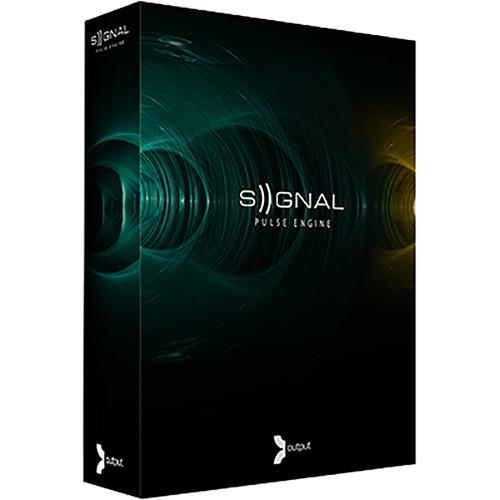 Contents of the user manual for the Output SIGNAL - Pulse Engine Virtual
- Product category: Virtual Instruments Output
- Brand: Output
- Description and content of package
- Technical information and basic settings
- Frequently asked questions – FAQ
- Troubleshooting (does not switch on, does not respond, error message, what do I do if...)
- Authorized service for Output Virtual Instruments
 |
User manual for the Output SIGNAL - Pulse Engine Virtual contain basic instructions
that need to be followed during installation and operation.
Before starting your appliance, the user manual should be read through carefully.
Follow all the safety instructions and warnings, and be guided by the given recommendations.
User manual is an integral part of any Output product,
and if it is sold or transferred, they should be handed over jointly with the product.
Following the instructions for use is an essential prerequisite for protecting
health and property during use, as well as recognition of liability on the part of the manufacturer
for possible defects should you make a warranty claim. Download an official Output user manual in which you will find instructions on how to install, use, maintain and service your product.
And do not forget – unsuitable use of a Output product will considerably shorten its lifespan!
|
Product description Output's Signal & Exhale: Powerful Electronic Music Plugins Read More - Output's Signal & Exhale: Powerful Electronic Music Plugins
SIGNAL - Pulse Engine from Output combines analog and digital synthesis with professionally recorded live instruments to create a powerful virtual instrument with vast sonic capabilities and an elegant, easy-to-use interface. Well suited for producers, composers and musicians, SIGNAL utilizes the Native Instruments Kontakt 5 player and is packed with over 40GB of professionally recorded content.
SIGNAL can create a broad palette of sounds by way of its pulse engines, which are broken into two layers, each with a channel strip and two rhythm generators. The source menu selects from a variety of sounds including sampled acoustic instruments or sampled synthesizer tones. For example, combining a distorted guitar and a cello creates a new and unheard sound source that is layered and can be further processed by the rhythm generators and built-in effects.
Selecting the rhythm tab opens options for selecting pulse type and pulse rate. Pulse types include selections for step-sequencer modulation, LFO wave-shaping modulations, an arpeggiator, and the infinitely repeating loop. There are several pre-made patterns for the arpeggiator and step sequencer and each can be used as is, modified, or cleared in order to make your own patterns from scratch.
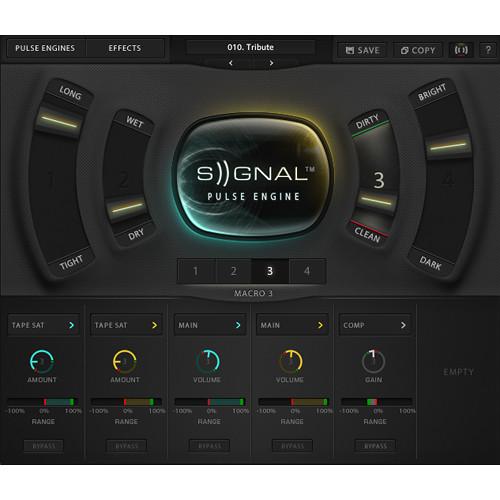
The advanced tab offers access to additional parameters and modulation controls including volume, panning, filter type, distortion, saturation, and envelope settings. The four macro sliders can control up to six parameters simultaneously with offsets to dial in the perfect range for sound control. The sliders provide a simple way to transform sounds and each preset offers its own unique set of macros for manipulating sounds.
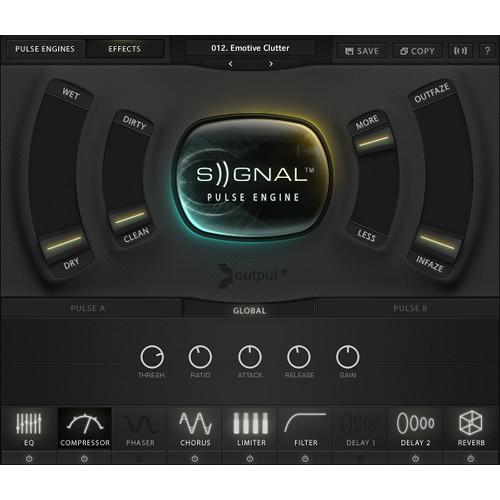
The effects section offers individual effects for each layer and includes EQ, Compression, Lo-Fi, Tape Saturation, Drive, Stereo Spread, Delay, Reverb, and Flutter. Additionally, the global effects process the sounds from both layers combined and include EQ, Compression, Phaser, Chorus, Limiter, Filter, Delays, and a high-quality Convolution Reverb.
All of the presets have been organized into the pulse instruments page. There is a list of over 500 presets and a tag list to help narrow the search for a particular type of sound. By selecting one or more tags, the full list is shortened to contain only presets with the selected attributes. -
- 500 Pulse Instruments for instant playability
- A massive array of content
- 40GB including analog synths, digital synths and organic instruments
- Up to 4 separate pulses at one time
- All pulses lock to tempo
- Rhythms: Looper, Step Sequencers, Arpeggiators, LFOs
- 4 central Macro sliders unique to each of the 500 Pulse Instruments
Table of Contents
|
Upload User Manual
Have you got an user manual for the Output SIGNAL - Pulse Engine Virtual Instrument in electronic form? Please send it to us and help us expand our library of instruction manuals.
Thank you, too, on behalf of other users.
To upload the product manual, we first need to check and make sure you are not a robot. After that, your "Submit Link" or "Upload File" will appear.
Technical parametersOutput SIGNAL Specs | System Requirements | Mac
OS X 10.7, OS X 10.8 or higher is recommended
Minimum 4 GB of RAM (8 GB recommended)
41 GB of free drive space
Access to a stable internet connection for digital delivery
PC
Windows 7 or higher
Minimum 4 GB of RAM (8 GB recommended)
41 GB of free drive space
Access to a stable internet connection for digital delivery | | Kontakt Player Requirements | Mac
Intel Core 2 Duo
OS X 10.8, 10.9 or 10.10 (latest update)
4 GB RAM (6 GB recommended for large Kontakt Instruments)
PC
Intel Core 2 Duo or AMD AthlonTM 64 X2
Windows 7 or Windows 8 (latest Service Pack, 32/64-bit)
Supported Interfaces
Stand-alone, VST, Audio Units, ASIO, Core Audio, WASAPI, AAX Native (Pro Tools 10 or higher)
All new Native Instruments software requires a minimum of OS X 10.8 or Windows 7.
Output can provide an install of 10.7/ REV compatible Kontakt 5.3.0 upon request. |
Rating70% users recommend this product to others. And what about you?

This product has already been rated by 41 owners. Add your rating and experience with the product.
Discussion
 Ask our technicians if you have a problem with your settings,
or if anything is unclear in the user manual you have downloaded.
You can make use of our moderated discussion.
The discussion is public and helps other users of our website who may be encountering similar problems.
Ask our technicians if you have a problem with your settings,
or if anything is unclear in the user manual you have downloaded.
You can make use of our moderated discussion.
The discussion is public and helps other users of our website who may be encountering similar problems.
The discussion is empty - enter the first post
Post a new topic / query / comment:
|
|
|
| Request for user manual |
You can’t find the operation manual you are looking for? Let us know and we will try to add the missing manual:
I’m looking for a manual / Request for manual
Current requests for instruction manuals:
Call Of Duty World War Two For Xbox...
controller stratus XL...
stratus XL...
smart whatch serie S11 42mm...
Allen & Heath SQ-6 manual...
|
| Discussion |
Latest contributions to the discussion:
AEW R 4100
Name: MAURICIO ANGARITA
Audio-Technica AEW-R4100 UHF Diversity Receiver for
AEW R 4100 has the mute function blocked and does not allow audio to pass. I tried several times to turn off the mute from the transmitter but it does nothing, the mute stays on. Solution?
Thank you...
Instructions for assembling the 2015 Forecast Image Master Consoles GC3-A
Name: mike elam
Forecast Consoles GC3-A ImageMaster Editing Console
Looking for instructions for assembling this console. ...
EMPTY TONER ERROR MESSAGE AFTER REPLACING TONER
Name: LINDA BAD YELLOW EYES
Brother TN223BK Standard-Yield Toner
I HAD TO CHANGE OUT ALL THREE TONERS DUE TO LEAKS IN THE YELLOW AND CYAN. AFTER I REPLACED THEM, THE MACHINE KEEPS GIVING ME AN EMPTY TONER ERROR MESSAGE. HELP!!...
PS480D 20/24 pin Switching 480W Power Supply
Name: swkargo
Logisys 480W Power Supply
This item states in can run -5vdc .It is NOT listed on the board or I beleive is r4 is missing the resitior. Any body have thid issue. Shawn
...
Help needed
Name: Ann Carter
SanDisk 1TB Extreme Portable USB 3.1
When I click the link to download the user manual for my Sandisk Extreme external hard drive, it gives me the manual for the LG Cricket. Can you please change the link so I can download the Sandisk manual and begin using this drive? Thank you....
|
|