|
User Manual for Radial Engineering JDX Direct Drive Amp Simulator and DI Box Click to enlarge the picture
 Contents of the user manual for the Radial Engineering JDX Direct Drive Amp
- Product category: General Guitar Accessories Radial Engineering
- Brand: Radial Engineering
- Description and content of package
- Technical information and basic settings
- Frequently asked questions – FAQ
- Troubleshooting (does not switch on, does not respond, error message, what do I do if...)
- Authorized service for Radial Engineering General Guitar Accessories
 |
User manual for the Radial Engineering JDX Direct Drive Amp contain basic instructions
that need to be followed during installation and operation.
Before starting your appliance, the user manual should be read through carefully.
Follow all the safety instructions and warnings, and be guided by the given recommendations.
User manual is an integral part of any Radial Engineering product,
and if it is sold or transferred, they should be handed over jointly with the product.
Following the instructions for use is an essential prerequisite for protecting
health and property during use, as well as recognition of liability on the part of the manufacturer
for possible defects should you make a warranty claim. Download an official Radial Engineering user manual in which you will find instructions on how to install, use, maintain and service your product.
And do not forget – unsuitable use of a Radial Engineering product will considerably shorten its lifespan!
|
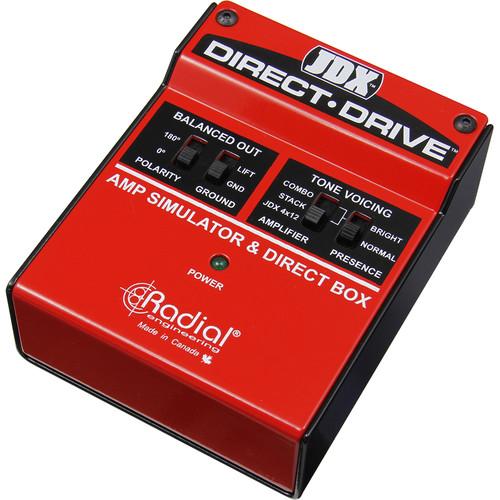
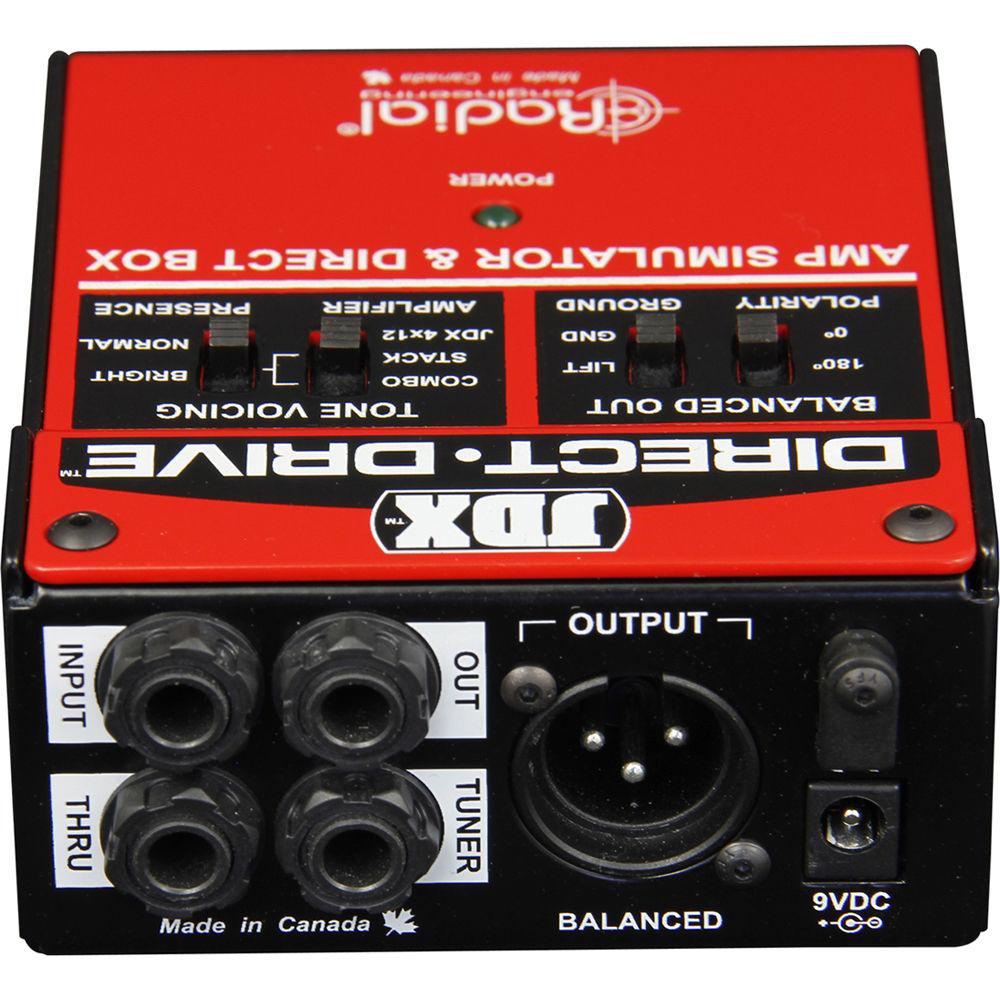
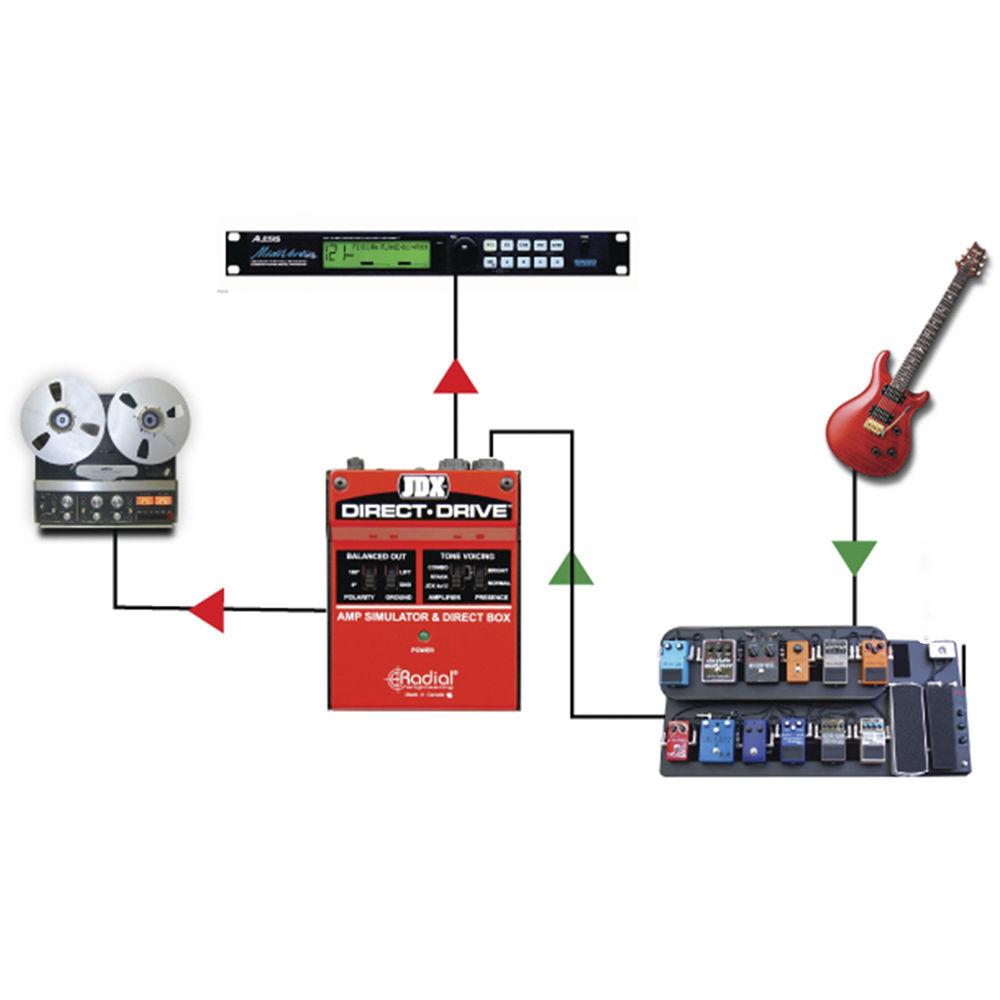
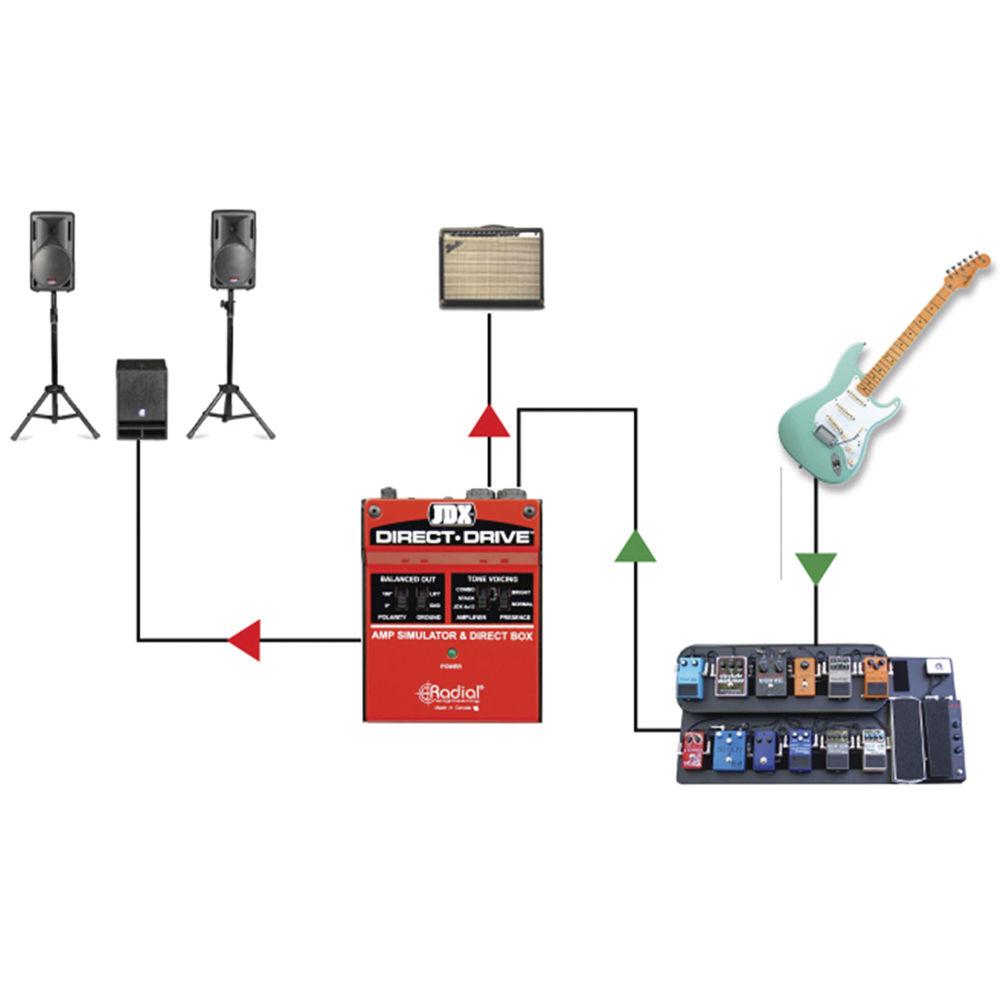
Product description The JDX Direct-Drive from Radial Engineering is an amp simulator for your pedalboard, giving you the tone and feel of not just one, but three different amp/cab configurations. With this pedal, you can very well avoid lugging an amplifier around town from gig to gig altogether, though the pedal does provide a passive thru-put to feed unprocessed signal to your onstage amplifier, should you choose to go that route anyway. A dedicated, buffered tuner output supplies any electronic tuner with guitar tone without extra loading on your pickup, or without introducing noise from quartz clocks.The pedal itself uses carefully tailored filters to create faithful emulations of caps, combos, and amp/cab configurations. You have choices here. You can select the COMBO setting, which models an early Fender Twin, or STACK mode, which mimics the timbre of a Marshall tube head feeding a 4x12 cabinet. JDX 4x12 Mode gives you the cabinet only, its tone specifically modelled to give you the sound of a cabinet mic’d by a Shure SM57 dynamic microphone. Both COMBO and STACK modes can receive even more tonal juicing from a special, two-position toggle switch, which lets you boost the highs for extra sparkle.For outputs, the pedal provides a standard, phone type 1/4” jack and a balanced XLR DI for feeding processed signal to the house, a mixer, or a recording interface. A 180° polarity-reverse switch allows you to phase-align the signal with your onstage amplifier, if it happened to be out of phase, while a ground switch eliminates hums and buzzing often associated with ground loops. The pedal runs off of 9 VDC, either from a pedalboard brick, or from a separately available power supply. - Controls at a Glance
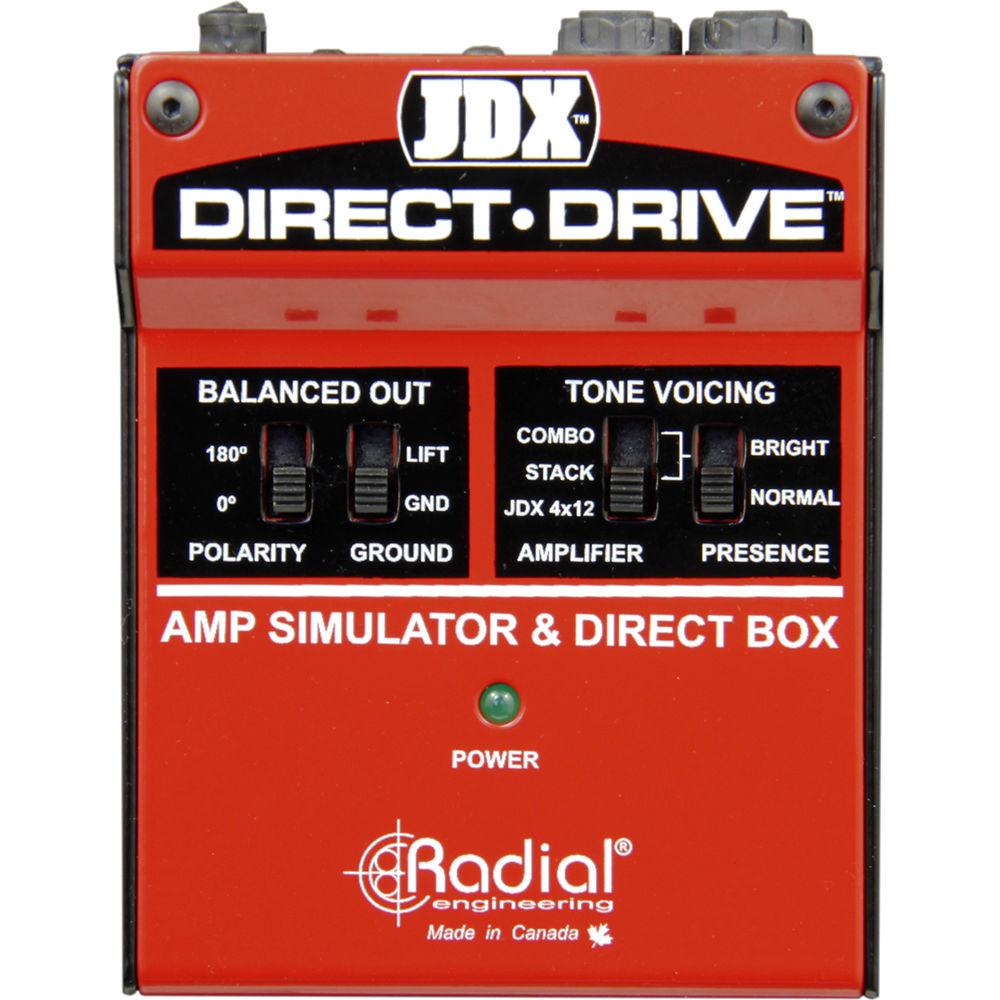
- POLARITY Toggleswitch: This toggles pin-2 and pin-3 on the XLR output, helping you phase-align your amp with stage monitors.GROUND Toggleswitch: This lifts Pin-1 on the balanced XLR output to help reduce the hum and buzzing caused by ground loops.AMPLIFIER Toggleswitch: Part of the Tone Voicing section, this three-position toggle offers three different amplifier emulations. COMBO models the tone of a Fender Twin, STACK mimics the timbre of a Marshall amp/cab configuration, and JDX 4x12 emulates only the sound of a 4x12 stack.PRESENCE Toggleswitch: Also part of the Tone Voicing section, this two-position switch provides extra sparkling highs for the STACK and COMBO settings.
- Connections at a Glance
- THRU: Use this to feed unprocessed tone to an on-stage amplifier, or a dry 1/4" studio DI input.TUNER: This Hi-Z always-on output can be used to connect to an electronic tuner.XLR: This balanced output is useful for feeding processed signal to a PA system or the XLR input of a recording device.
UPC: 676101044160 In the Box Radial Engineering JDX Direct Drive Amp Simulator and DI Box Limited 3-Year Warranty Table of Contents
|
Upload User Manual
Have you got an user manual for the Radial Engineering JDX Direct Drive Amp Simulator and DI Box in electronic form? Please send it to us and help us expand our library of instruction manuals.
Thank you, too, on behalf of other users.
To upload the product manual, we first need to check and make sure you are not a robot. After that, your "Submit Link" or "Upload File" will appear.
Technical parametersRadial Engineering R800 1404 Specs | Controls | POLARITY Toggleswitch
GROUND Toggleswitch
AMPLIFIER Toggleswitch
PRESENCE Toggleswitch | | Connections | 1 x 1/4" Instrument input, phone type
1 x 1/4" Instrument output, phone type
1 x 1/4" Thru output, phone type
1 x 1/4" Tuner output, phone type
1 x XLR Balanced DI output | | Audio Circuit Type | Class-A BiFET input buffer with electronic frequency shaping circuitry | | Dynamic Range | 83 to 100 dB | | Gain | Maximum gain, input to XLR output: 0 dB
minimum gain, input to 1/4" output: -5.8 dB | | Noise Floor | -78 dBu | | Maximum Input | > +5 dBu | | Total Harmonic Distortion | < 0.01% | | Inter-Modulation Distortion | > 0.1% at -15 dBu out | | Output Impedance | XLR output: 600 Ohms
1/4" output: 100 Ohms | | Output Clip Level | XLR output: > +5 dBu | | Construction | 14-gauge steel chassis and outer shell | | Finish | Powder coat | | Power | 40 mA, 9 VDC | | Dimensions (L x W x H) | 4.8 x 3.6 x 2.0" / 120.7 x 92.1 x 50.8 mm | | Weight | 1.6 lb / 0.7 kg | | | | Package Weight | 1.75 lb | | Box Dimensions (LxWxH) | 6.3 x 4.3 x 2.9" |
Rating90% users recommend this product to others. And what about you?

This product has already been rated by 76 owners. Add your rating and experience with the product.
Discussion
 Ask our technicians if you have a problem with your settings,
or if anything is unclear in the user manual you have downloaded.
You can make use of our moderated discussion.
The discussion is public and helps other users of our website who may be encountering similar problems.
Ask our technicians if you have a problem with your settings,
or if anything is unclear in the user manual you have downloaded.
You can make use of our moderated discussion.
The discussion is public and helps other users of our website who may be encountering similar problems.
The discussion is empty - enter the first post
Post a new topic / query / comment:
|
|
|
| Request for user manual |
You can’t find the operation manual you are looking for? Let us know and we will try to add the missing manual:
I’m looking for a manual / Request for manual
Current requests for instruction manuals:
Call Of Duty World War Two For Xbox...
controller stratus XL...
stratus XL...
smart whatch serie S11 42mm...
Allen & Heath SQ-6 manual...
|
| Discussion |
Latest contributions to the discussion:
AEW R 4100
Name: MAURICIO ANGARITA
Audio-Technica AEW-R4100 UHF Diversity Receiver for
AEW R 4100 has the mute function blocked and does not allow audio to pass. I tried several times to turn off the mute from the transmitter but it does nothing, the mute stays on. Solution?
Thank you...
Instructions for assembling the 2015 Forecast Image Master Consoles GC3-A
Name: mike elam
Forecast Consoles GC3-A ImageMaster Editing Console
Looking for instructions for assembling this console. ...
EMPTY TONER ERROR MESSAGE AFTER REPLACING TONER
Name: LINDA BAD YELLOW EYES
Brother TN223BK Standard-Yield Toner
I HAD TO CHANGE OUT ALL THREE TONERS DUE TO LEAKS IN THE YELLOW AND CYAN. AFTER I REPLACED THEM, THE MACHINE KEEPS GIVING ME AN EMPTY TONER ERROR MESSAGE. HELP!!...
PS480D 20/24 pin Switching 480W Power Supply
Name: swkargo
Logisys 480W Power Supply
This item states in can run -5vdc .It is NOT listed on the board or I beleive is r4 is missing the resitior. Any body have thid issue. Shawn
...
Help needed
Name: Ann Carter
SanDisk 1TB Extreme Portable USB 3.1
When I click the link to download the user manual for my Sandisk Extreme external hard drive, it gives me the manual for the LG Cricket. Can you please change the link so I can download the Sandisk manual and begin using this drive? Thank you....
|
|