|
User Manual for Radial Engineering Jensen Twin-Servo 500 Series Mic Preamp Click to enlarge the picture
 Contents of the user manual for the Radial Engineering Jensen Twin-Servo 500 Series
- Product category: Microphone Preamps Radial Engineering
- Brand: Radial Engineering
- Description and content of package
- Technical information and basic settings
- Frequently asked questions – FAQ
- Troubleshooting (does not switch on, does not respond, error message, what do I do if...)
- Authorized service for Radial Engineering Microphone Preamps
 |
User manual for the Radial Engineering Jensen Twin-Servo 500 Series contain basic instructions
that need to be followed during installation and operation.
Before starting your appliance, the user manual should be read through carefully.
Follow all the safety instructions and warnings, and be guided by the given recommendations.
User manual is an integral part of any Radial Engineering product,
and if it is sold or transferred, they should be handed over jointly with the product.
Following the instructions for use is an essential prerequisite for protecting
health and property during use, as well as recognition of liability on the part of the manufacturer
for possible defects should you make a warranty claim. Download an official Radial Engineering user manual in which you will find instructions on how to install, use, maintain and service your product.
And do not forget – unsuitable use of a Radial Engineering product will considerably shorten its lifespan!
|
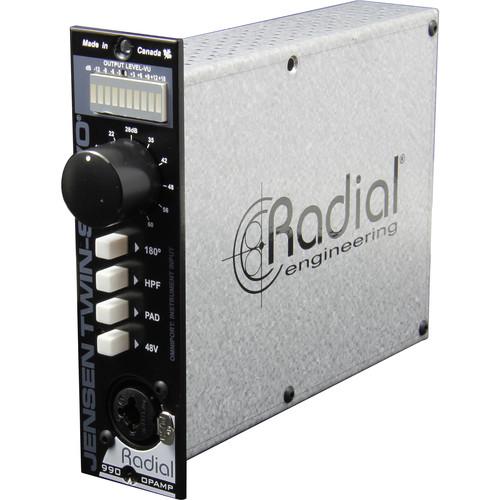
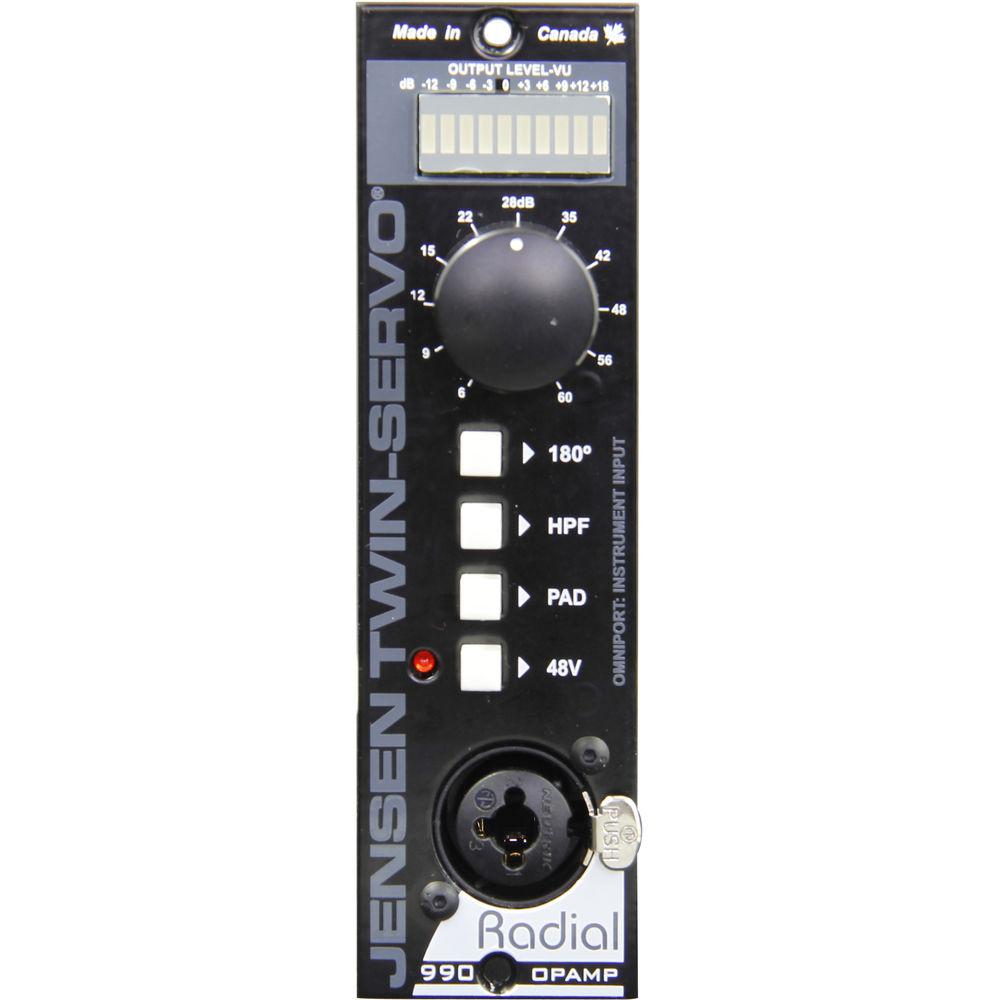
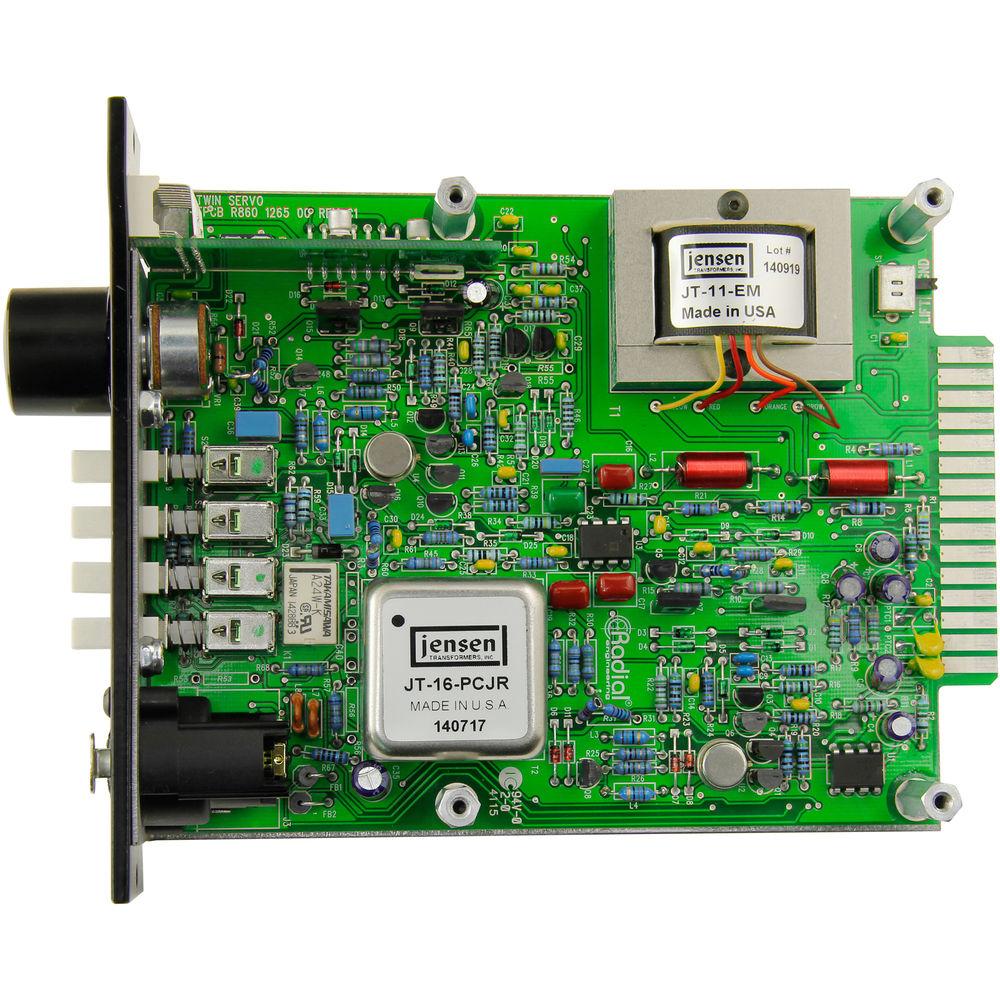
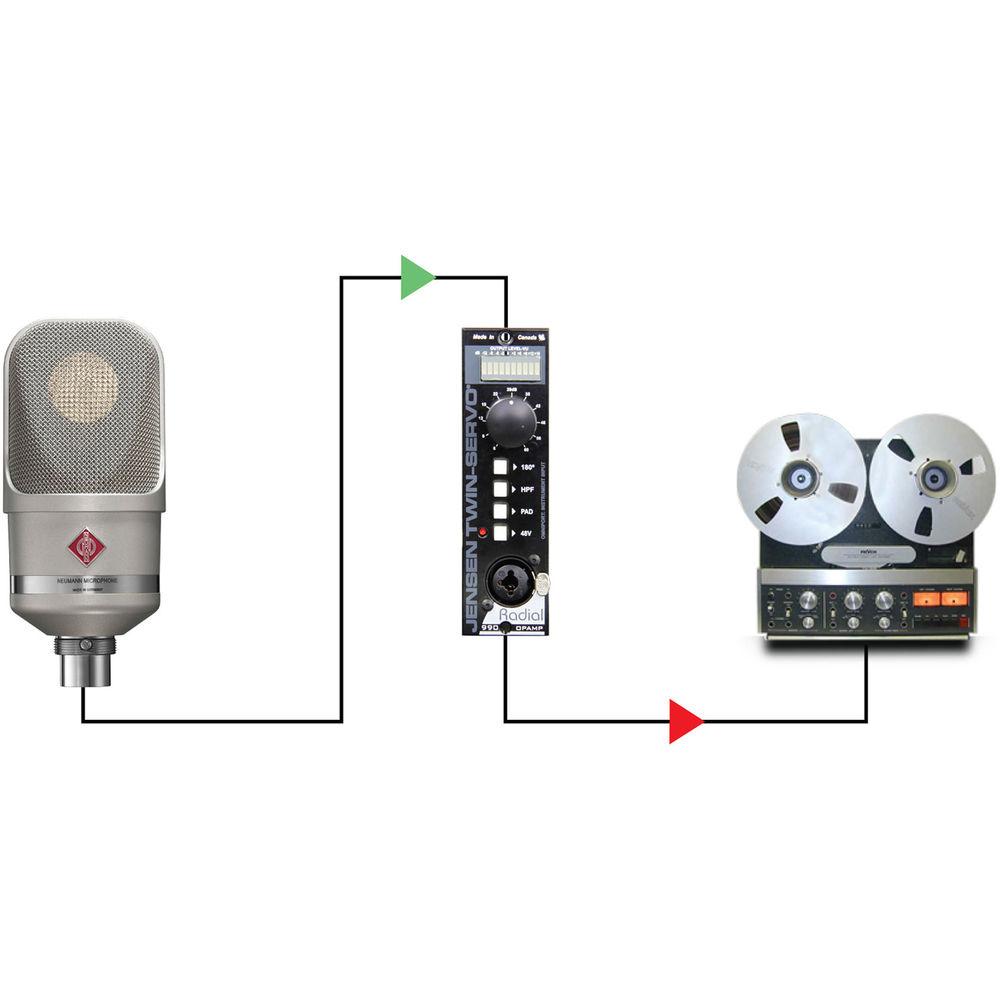
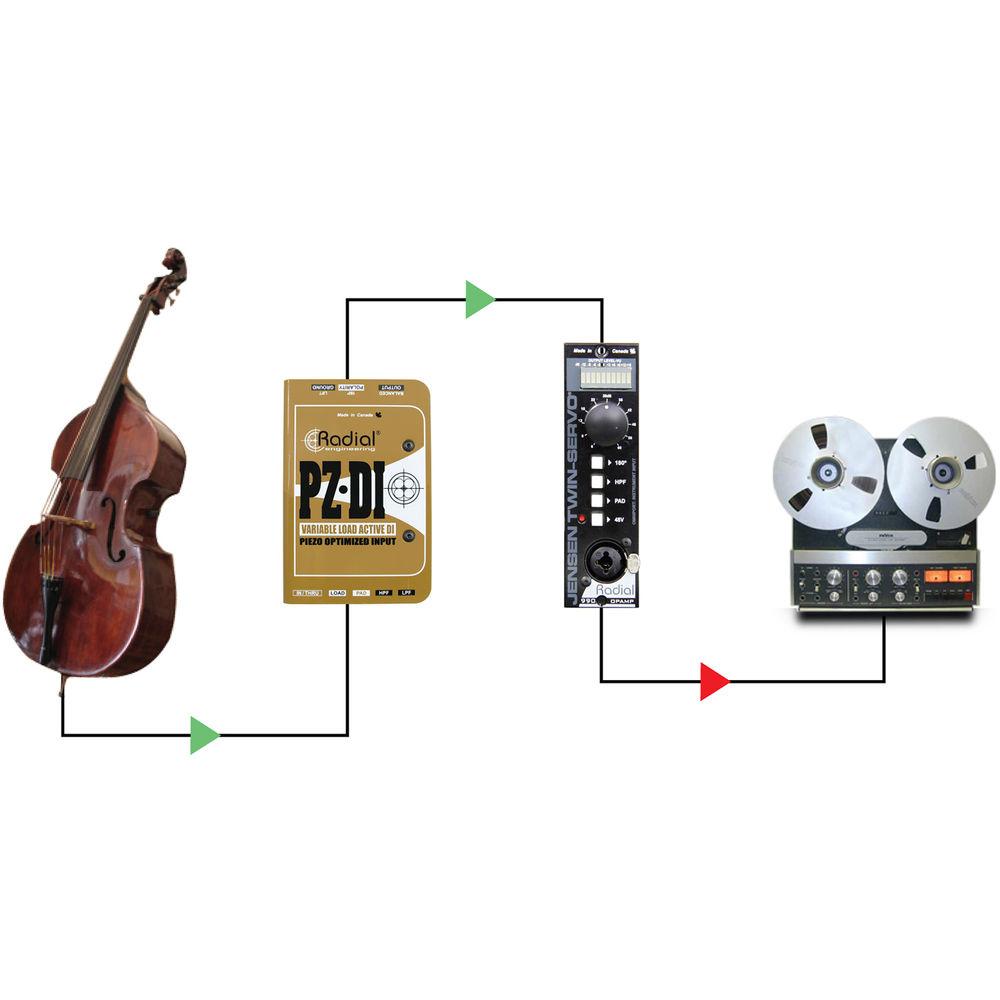
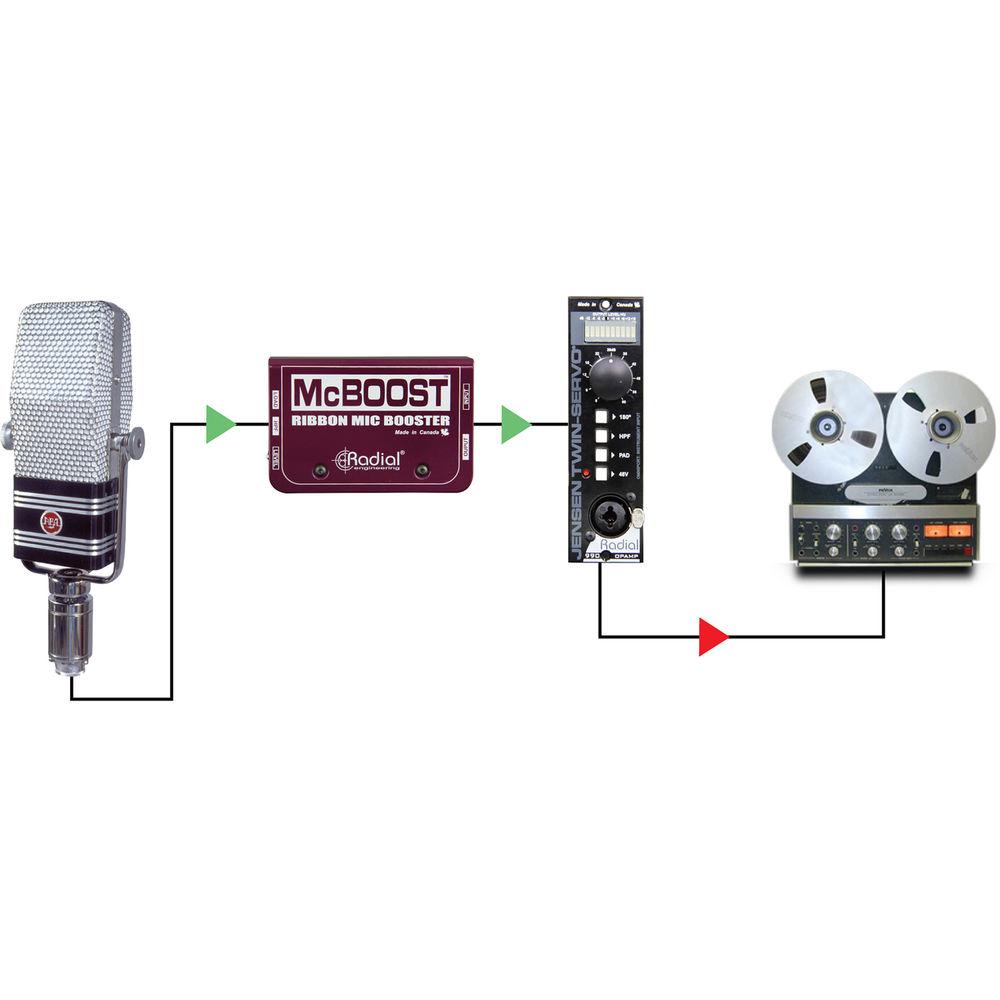
Product description The Radial Engineering Jensen Twin-Servo 500 Series Mic Preamp is a faithful recreation of Deane Jensen's original Twin-Servo 990 mic pre, regarded by many audio professionals as one of the finest preamps ever made. This mic preamp has pedigree. The circuit designed by the Jensen engineering team includes two cascaded 990 op-amps to share the load and provide 60 dB of clean gain. The two servos eliminate the need for signal-degrading capacitors in the audio path and allow for less than -120 dBu of noise. Engineered for superior sound quality, the two oversized input and output Jensen transformers are a crucial part of the design. They contribute to lowering the noise floor and freeing the signal from hum and RF interference, while producing an extended frequency response and plenty of headroom. Augmented by a 180º polarity-reverse switch, a -15 dB pad, and a high-pass filter that eliminates excessive low-end, the Twin-Servo opens musical tone-shaping possibilities. Other features include a dual-gang potentiometer for optimal gain, a 10-segment LED meter that gives instant visual feedback for the input signal and a 48V phantom power-activation switch to power condenser microphones. The front-panel Neutrik combo connector offers the choice of XLR microphone input and standard hi-Z 1/4" instrument input. Re-imagined for today, this adaptation of the Jensen Twin-Servo fits the popular 500 series format. - Jensen Mic Input Transformer
- The JT-16-PCJR is exceptionally quiet and linear from 5 Hz to 50 kHz with less than 0.06% distortion at 20 Hz
- Jensen Dual Op-Amps
- 100% discrete audio signal path without any tone-shifting capacitors
- Jensen Output Transformer
- The JT-11-EM is linear from 2 Hz to 200 kHz with less than 0.001% distortion at 20 Hz
- 180° Polarity-Reverse Switch
- Reverses pins 2 and 3 at the output to help phase-align microphones when two channels are in stereo use
- 10-Segment Meter
- 10-Segment Peak Indicator with Hold. Custom-designed circuit for greater VU accuracy
- Dual-Gang Pot
- Simultaneously controls the dual-990 op-amp topology for optimal gain at all levels
- High-Pass Filter
- Gentle high-pass filter may be inserted into the signal path to reduce excessive low-frequency content and control resonance
- Pad
- Reduces the input sensitivity by -15 dB when amplifying exceedingly high output sources
- 48V
- Activates the 48V phantom power supply for use with condenser microphones and active direct boxes
- Combo Input
- Combination balanced XLR mic input and 1/4" instrument input is mounted on front panel for ease of use
- Ground Lift Switch
- Set-and-forget rear-panel ground switch lifts the pin-1 ground at the XLR input
- Omniport
- Available when used with the Radial Workhorse, the Omniport accesses a hi-Z instrument input
- Full Enclosure
- 100% encased steel casing reduces magnetic interference from nearby modules that may cause noise pollution
UPC: 676101044238 In the Box Radial Engineering Jensen Twin-Servo 500 Series Mic Preamp 3-Year Limited Warranty Table of Contents
|
Upload User Manual
Have you got an user manual for the Radial Engineering Jensen Twin-Servo 500 Series Mic Preamp in electronic form? Please send it to us and help us expand our library of instruction manuals.
Thank you, too, on behalf of other users.
To upload the product manual, we first need to check and make sure you are not a robot. After that, your "Submit Link" or "Upload File" will appear.
Technical parametersRadial Engineering R700 0111 Specs | Circuit Type | Two-stage variable gain, all discrete using original Deane Jensen circuit with IC DC servo
Jensen transformer-coupled input and output | | Microphone Input | Transformer-coupled, Jensen JT-15KE | | Polarity Reverse | 180° | | Frequency Response | 14 Hz to 85 kHz / 8 Hz to 100 kHz (±1 dB / ±3 dB) | | Pad | -15 dB | | XLR Configuration | AES spec: pin-1 ground, pin-2 (+), pin-3 (-) | | Intermodulation Distortion | 0.004% | | Dynamic Range | 91 dB | | Input Impedance | XLR Input: 1.3 kOhm
Instrument Input: 220 kOhms / unbalanced | | Output Impedance | 75 Ohms | | Maximum Output | +22 dBu | | Mic Pre Gain | +60 dB | | Common Mode Rejection | -72 dB | | Equivalent Input Noise | -120 dBu @ maximum gain | | Total Harmonic Distortion (THD) + N | 0.004% | | Phantom Power | 48 VDC - 10 mA (as supplied by 500 frame) | | High Pass Filter | 6 dB/octave, @ 150 Hz | | Form Factor | 500 Series module | | Power | 110 mA | | Environmental Conditions | For use in dry locations only between 5°C and 40°C (41°F and 104°F) | | Dimensions (H x W x D) | 5.25 x 1.5 x 7" (134 x 38 x 178 mm) | | Weight | 1.75 lb (0.79 kg) | | | | Package Weight | 2.25 lb | | Box Dimensions (LxWxH) | 8.976 x 6.614 x 1.89" |
Rating100% users recommend this product to others. And what about you?

This product has already been rated by 74 owners. Add your rating and experience with the product.
Discussion
 Ask our technicians if you have a problem with your settings,
or if anything is unclear in the user manual you have downloaded.
You can make use of our moderated discussion.
The discussion is public and helps other users of our website who may be encountering similar problems.
Ask our technicians if you have a problem with your settings,
or if anything is unclear in the user manual you have downloaded.
You can make use of our moderated discussion.
The discussion is public and helps other users of our website who may be encountering similar problems.
The discussion is empty - enter the first post
Post a new topic / query / comment:
|
|
|
| Request for user manual |
You can’t find the operation manual you are looking for? Let us know and we will try to add the missing manual:
I’m looking for a manual / Request for manual
Current requests for instruction manuals:
Call Of Duty World War Two For Xbox...
controller stratus XL...
stratus XL...
smart whatch serie S11 42mm...
Allen & Heath SQ-6 manual...
|
| Discussion |
Latest contributions to the discussion:
AEW R 4100
Name: MAURICIO ANGARITA
Audio-Technica AEW-R4100 UHF Diversity Receiver for
AEW R 4100 has the mute function blocked and does not allow audio to pass. I tried several times to turn off the mute from the transmitter but it does nothing, the mute stays on. Solution?
Thank you...
Instructions for assembling the 2015 Forecast Image Master Consoles GC3-A
Name: mike elam
Forecast Consoles GC3-A ImageMaster Editing Console
Looking for instructions for assembling this console. ...
EMPTY TONER ERROR MESSAGE AFTER REPLACING TONER
Name: LINDA BAD YELLOW EYES
Brother TN223BK Standard-Yield Toner
I HAD TO CHANGE OUT ALL THREE TONERS DUE TO LEAKS IN THE YELLOW AND CYAN. AFTER I REPLACED THEM, THE MACHINE KEEPS GIVING ME AN EMPTY TONER ERROR MESSAGE. HELP!!...
PS480D 20/24 pin Switching 480W Power Supply
Name: swkargo
Logisys 480W Power Supply
This item states in can run -5vdc .It is NOT listed on the board or I beleive is r4 is missing the resitior. Any body have thid issue. Shawn
...
Help needed
Name: Ann Carter
SanDisk 1TB Extreme Portable USB 3.1
When I click the link to download the user manual for my Sandisk Extreme external hard drive, it gives me the manual for the LG Cricket. Can you please change the link so I can download the Sandisk manual and begin using this drive? Thank you....
|
|