|
User Manual for RME MADIface USB 128-Channel USB Interface for Mobile Computers Click to enlarge the picture
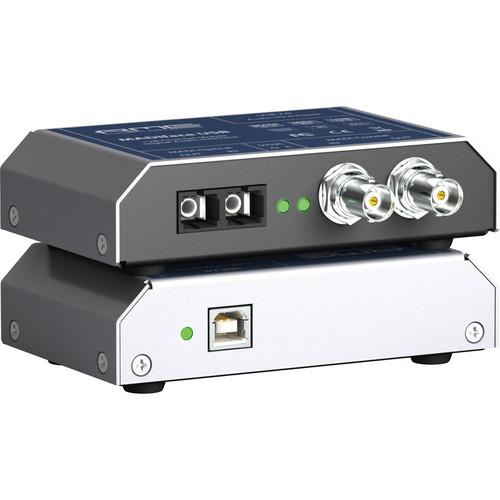 Contents of the user manual for the RME MADIface USB 128-Channel USB Interface
- Product category: Audio Interfaces & Systems RME
- Brand: RME
- Description and content of package
- Technical information and basic settings
- Frequently asked questions – FAQ
- Troubleshooting (does not switch on, does not respond, error message, what do I do if...)
- Authorized service for RME Audio Interfaces & Systems
 |
User manual for the RME MADIface USB 128-Channel USB Interface contain basic instructions
that need to be followed during installation and operation.
Before starting your appliance, the user manual should be read through carefully.
Follow all the safety instructions and warnings, and be guided by the given recommendations.
User manual is an integral part of any RME product,
and if it is sold or transferred, they should be handed over jointly with the product.
Following the instructions for use is an essential prerequisite for protecting
health and property during use, as well as recognition of liability on the part of the manufacturer
for possible defects should you make a warranty claim. Download an official RME user manual in which you will find instructions on how to install, use, maintain and service your product.
And do not forget – unsuitable use of a RME product will considerably shorten its lifespan!
|
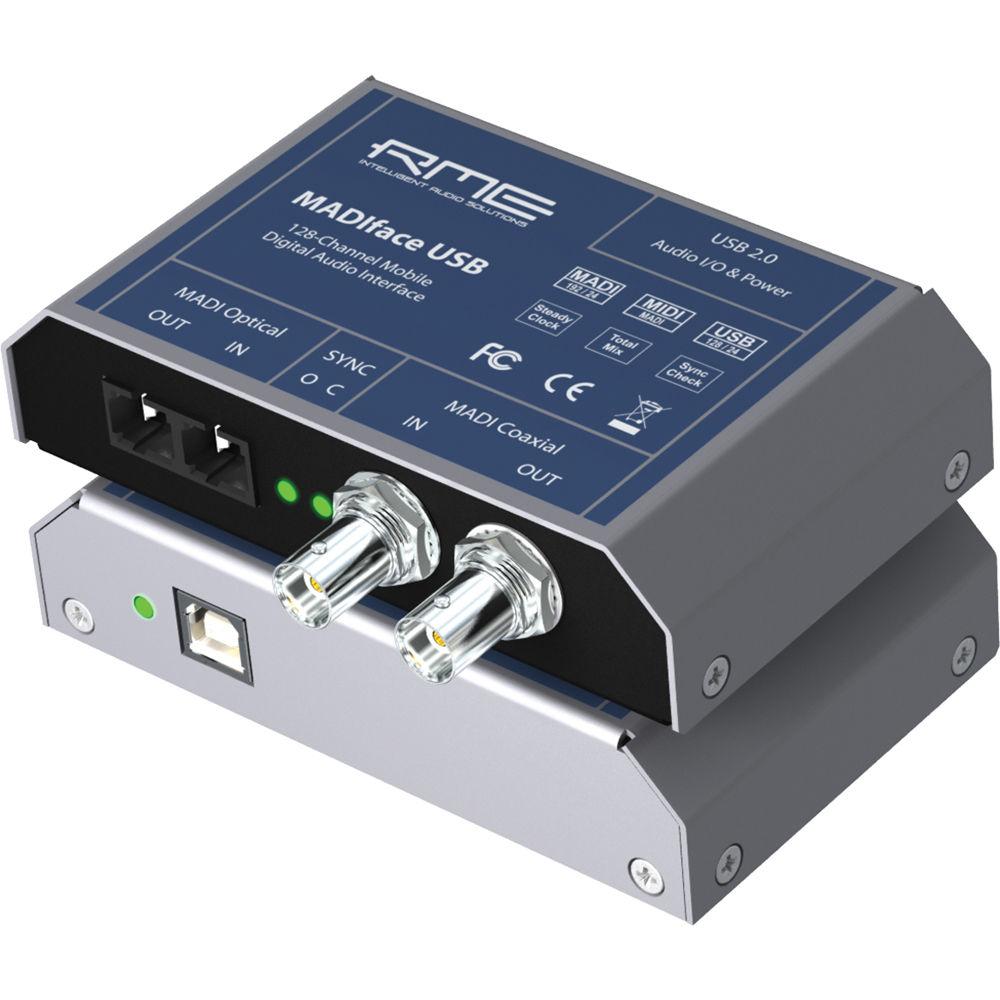
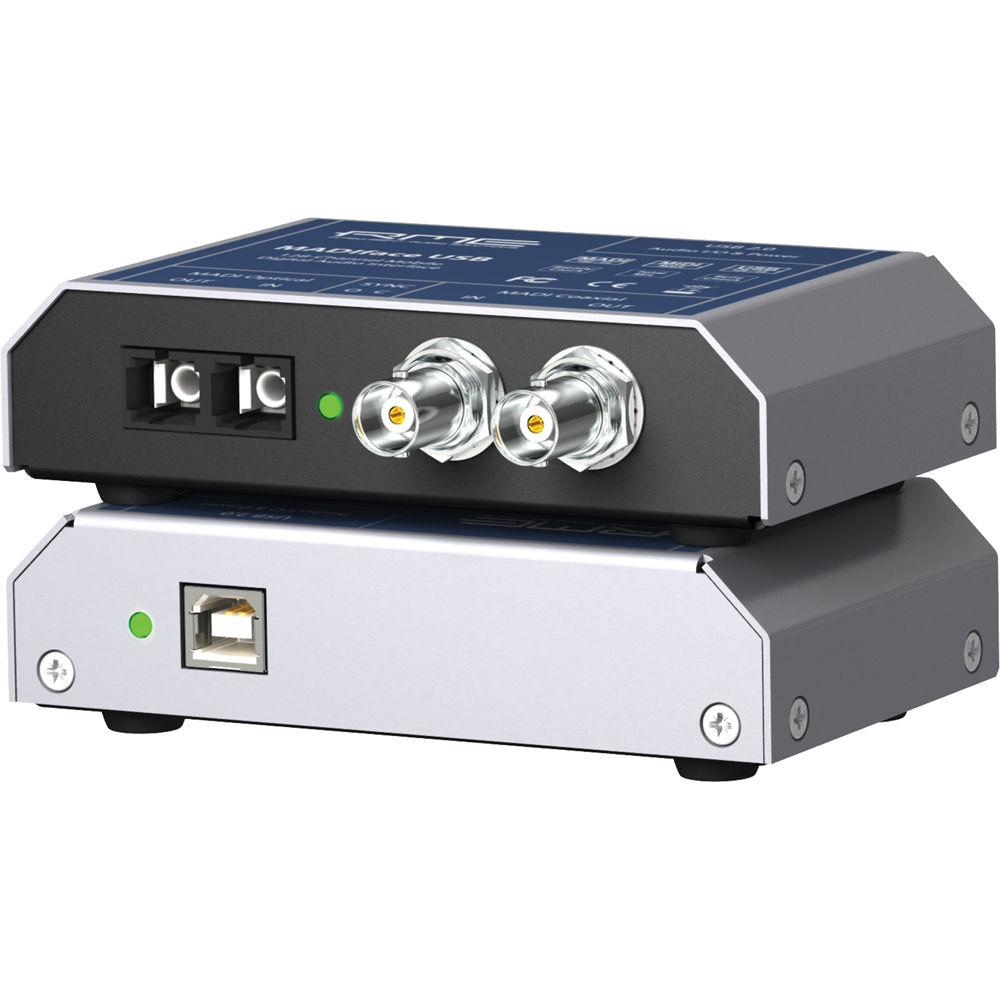
Product description The MADIface USB 128-Channel USB Interface from RME provides MADI I/O via USB 2.0 ports while supporting the format's full 64 channels for recording and playback, on both Mac and Windows.
The unit's two inputs can be used for full redundancy operation or used simultaneously for full 128 channel input and output access, mixed and routed by RME's TotalMix software. Without a computer, the MADIface USB provides bi-directional format conversion and can function as an active repeater. - Features
- MADIface USB offers several operation modes when used with a Mac or Windows computer: 64 Channel Mix, Redundancy mode, 128 Channel Mix and a straight routing mode.
The option Disable TotalMix completely disables TotalMix, the unit's internal mixer and routing matrix. All input and output data is going straight to record/coming from playback, with no mixing or routing involved. In this mode the outputs are mirrored, carrying the same signal.
In 64 Channel Mix mode TotalMix shows 64 input, playback and output channels. All settings in TotalMix use the data from one MADI input port, and send identical data to both MADI output ports. The currently active MADI input port can be configured in the Settings dialog
The option AutoSelect activates an automatic input selection. Using both inputs at the same time, AutoSelect puts the device into Seamless Redundancy mode. The MADIface USB will switch to the other input in real-time if the current one fails.
In 128 Channel Mix mode record and playback is still limited to 64 channels, with the current input selected in the Settings dialog. But the other input is also available through TotalMix, and the output signal is not mirrored, but separated, with TotalMix having 128 output channels. Applications like independent mix output, monitoring and serial pass-through of the second source are just a few clicks away
SteadyClock as well as RME's well known MADI compatibility ensure operation with other devices. MIDI over MADI technology may be used to remote-control other MADI devices. DIGICheck, an included complete audio analyzing suite, supports the user under Mac OS X and Windows - TotalMix
- The MADIface USB also includes the powerful digital real-time mixer TotalMix FX. It allows for versatile mixing and routing operations, with all inputs and playback channels simultaneously, to any hardware outputs. It includes a dedicated Control Room section with talkback, main/phones, fader groups, mute groups, complete remote controllability via Mackie or OSC protocol, and much more.
Here are some typical applications for TotalMix: - Setting up delay-free sub-mixes (headphone mixes). The MADIface allows for up to 32 fully independent stereo sub-mixes. On an analog mixing desk, this would equal 64 Aux sends.
- Unlimited routing of inputs and outputs (free utilization, patchbay functionality).
- Distributing signals to several outputs at a time. TotalMix offers splitter and distributor functions.
- Simultaneous playback of different programs via a single stereo output. The ASIO multiclient driver supports the usage of several programs at the same time. When done on different playback channels TotalMix provides the means to mix and monitor these on a single stereo output.
- Mixing of the input signal to the playback signal (complete ASIO Direct Monitoring).
- Integration of external devices. Use TotalMix to insert external effects devices, be it in the playback or in the record path. Depending on the current application, the functionality equals insert or effects send and effects return, for example as used during real-time monitoring when adding some reverb to the vocals.
- Stand-Alone Operation
- For stand-alone operation the MADIface USB can be powered by any USB power wall wart or USB battery, like those for mobile phones and MP3 players. Without a computer host the device enters a pre-configured mode. Using one input the MADIface USB is clock slave, using the sample rate found at the input. AutoSelect is active, so either input can be used. The input's audio data is transferred to the outputs unchanged. The output format follows the input format (56/64 channel mode, 48k/96k Frame). Using two inputs Double Processing Mode becomes active, for two independent paths, including two SteadyClocks. The internal routing changes from parallel output to cross-coupled. Therefore in stand-alone mode the unit automatically operates as active repeater, effectively doubling the maximum cable length of 100 m coaxial and 2,000 m optical. With two inputs connected the unit works as bi-directional format converter, converting coaxial to optical and vice versa simultaneously. This is even possible when the connected device uses sample rate converters for independent clocking - the sample rate can be different in both paths
In the Box RME MADIface USB 128-Channel USB Interface for Mobile Computers Measurement, Analysis and Test Tool Limited 2-Year Warranty User Manual PDF 873.6kb Table of Contents
|
Upload User Manual
Have you got an user manual for the RME MADIface USB 128-Channel USB Interface for Mobile Computers in electronic form? Please send it to us and help us expand our library of instruction manuals.
Thank you, too, on behalf of other users.
To upload the product manual, we first need to check and make sure you are not a robot. After that, your "Submit Link" or "Upload File" will appear.
Technical parametersRME MADIface Specs | | | Max Sample Rate/Resolution | 192 kHz / 24-Bit | | | | Host Connection | USB Type-B (USB 2.0) | | Analog I/O | None | | Digital I/O | 1 x BNC / Coaxial MADI Input
1 x BNC / Coaxial MADI Output
1 x SC-Plug / Optical MADI Input
1 x SC-Plug / Optical MADI Output | | MIDI I/O | None | | | | Sample Rates | 44.1, 48, 88.2, 96, 176.4, and 192 kHz | | | | OS Compatibility | Windows 7
Windows 8
macOS 10.6 or Later | | | | Package Weight | 1.35 lb | | Box Dimensions (LxWxH) | 11.7 x 6.8 x 2.8" |
Rating90% users recommend this product to others. And what about you?

This product has already been rated by 36 owners. Add your rating and experience with the product.
Discussion
 Ask our technicians if you have a problem with your settings,
or if anything is unclear in the user manual you have downloaded.
You can make use of our moderated discussion.
The discussion is public and helps other users of our website who may be encountering similar problems.
Ask our technicians if you have a problem with your settings,
or if anything is unclear in the user manual you have downloaded.
You can make use of our moderated discussion.
The discussion is public and helps other users of our website who may be encountering similar problems.
The discussion is empty - enter the first post
Post a new topic / query / comment:
|
|
|
| Request for user manual |
You can’t find the operation manual you are looking for? Let us know and we will try to add the missing manual:
I’m looking for a manual / Request for manual
Current requests for instruction manuals:
Call Of Duty World War Two For Xbox...
controller stratus XL...
stratus XL...
smart whatch serie S11 42mm...
Allen & Heath SQ-6 manual...
|
| Discussion |
Latest contributions to the discussion:
AEW R 4100
Name: MAURICIO ANGARITA
Audio-Technica AEW-R4100 UHF Diversity Receiver for
AEW R 4100 has the mute function blocked and does not allow audio to pass. I tried several times to turn off the mute from the transmitter but it does nothing, the mute stays on. Solution?
Thank you...
Instructions for assembling the 2015 Forecast Image Master Consoles GC3-A
Name: mike elam
Forecast Consoles GC3-A ImageMaster Editing Console
Looking for instructions for assembling this console. ...
EMPTY TONER ERROR MESSAGE AFTER REPLACING TONER
Name: LINDA BAD YELLOW EYES
Brother TN223BK Standard-Yield Toner
I HAD TO CHANGE OUT ALL THREE TONERS DUE TO LEAKS IN THE YELLOW AND CYAN. AFTER I REPLACED THEM, THE MACHINE KEEPS GIVING ME AN EMPTY TONER ERROR MESSAGE. HELP!!...
PS480D 20/24 pin Switching 480W Power Supply
Name: swkargo
Logisys 480W Power Supply
This item states in can run -5vdc .It is NOT listed on the board or I beleive is r4 is missing the resitior. Any body have thid issue. Shawn
...
Help needed
Name: Ann Carter
SanDisk 1TB Extreme Portable USB 3.1
When I click the link to download the user manual for my Sandisk Extreme external hard drive, it gives me the manual for the LG Cricket. Can you please change the link so I can download the Sandisk manual and begin using this drive? Thank you....
|
|