|
User Manual for SPL MTC Monitor and Talkback Controller Click to enlarge the picture
 Contents of the user manual for the SPL MTC Monitor and Talkback Controller
- Product category: Studio Monitor Controllers SPL
- Brand: SPL
- Description and content of package
- Technical information and basic settings
- Frequently asked questions – FAQ
- Troubleshooting (does not switch on, does not respond, error message, what do I do if...)
- Authorized service for SPL Studio Monitor Controllers
 |
User manual for the SPL MTC Monitor and Talkback Controller contain basic instructions
that need to be followed during installation and operation.
Before starting your appliance, the user manual should be read through carefully.
Follow all the safety instructions and warnings, and be guided by the given recommendations.
User manual is an integral part of any SPL product,
and if it is sold or transferred, they should be handed over jointly with the product.
Following the instructions for use is an essential prerequisite for protecting
health and property during use, as well as recognition of liability on the part of the manufacturer
for possible defects should you make a warranty claim. Download an official SPL user manual in which you will find instructions on how to install, use, maintain and service your product.
And do not forget – unsuitable use of a SPL product will considerably shorten its lifespan!
|
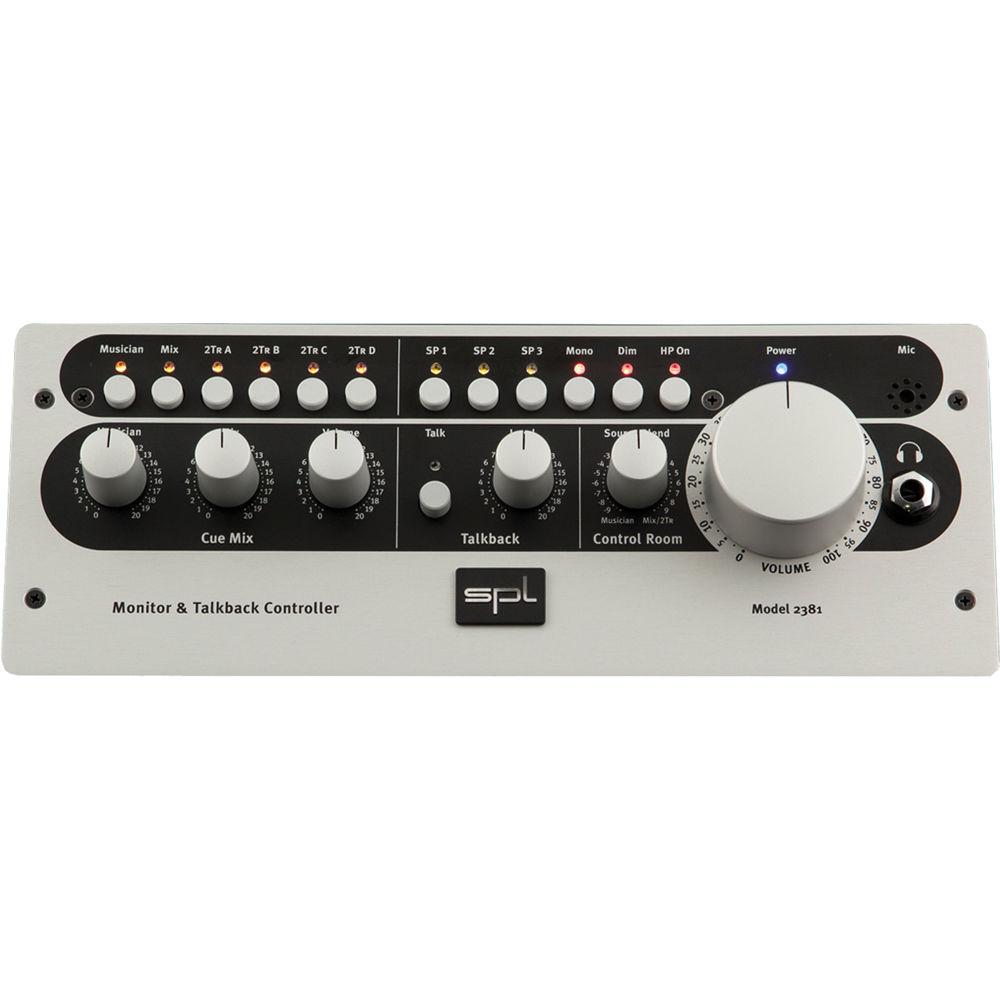
Product description The MTC Monitor and Talkback Controller from SPL is a stereo volume, source and monitor controller with cue mixing and talkback functions. The MTC combines volume level control, source switching and loudspeaker management for stereo monitoring with talkback and cue mixing functions. A fully analog design dispenses with VCAs, DACs, etc., with the MTC designed to provide loss-free signal processing monitoring. The I/O section includes six rear-panel stereo inputs (four balanced, two unbalanced sources), balanced XLR outputs for three loudspeaker pairs and a slave output.
The design focus of the MTC is on essential playback services, and it is ergonomically engineered to provide sensible playback function for DAW-based monitor management - in all areas of stereo audio production, from recording studios over movie and video post production, to game/multimedia production.
The MTC is designed to work with audio and video production tools such as ProTools, Nuendo, Cubase, Logic, Deck and many other hardware and software sound and video production hardware and software. And for sound quality, the fully analog signal path of the MTC can enhance digital formats. - Cue Mix and Talkback
- The latency-free cue mix signal for the musician can be composed of the musician's track and the track mix. The Talkback communications option via built-in microphone provides a footswitch input for remote control and a separate output with the dry talkback signal. These features mean that monitoring in any DAW-based studio now can be expanded to include the kind of essential functionality that is usually only available in large analog consoles.
- Status LEDs
- An LED over each front panel switch indicates activity by illuminating when its corresponding switch is turned on. If the Talkback function is activated by an external switch, the Talk LED will nonetheless illuminate.
- Master Volume
- The master volume potentiometer globally controls volume for up to three stereo speaker pairs. This analog control regulates the audio signal directly to avoid any coloration/distortion typical of VCAs, DCAs, etc., which require higher inter-channel tolerances and tend toward higher distortion figures. Moreover, this potentiometer possesses a rotational torque and "feel" for more precise hand control.
- Speaker Calibration
- The MTC dispenses with speaker output trims, as they would unnecessarily stress the signal patches - all active speakers and also power amps have input trims. The adjustment process should begin with the quietest monitor pair (smallest sound pressure level) with the input sensitivity at maximum level. Leaving the MTC Master Volume control as set, you then perform the same adjustment for the other monitor/speaker pairs until each produces the same sound level as the first pair. Lacking a sound pressure level meter, you may still accomplish this adjustment by ear.
- Footswitch
- This 1/4 inch footswitch input can accept an on/off switch or key that allows remote control of the Talkback function. Any sort of switch or key (including footswitches familiar to keyboard players) can be used here.
- Slave Output
- The balanced 1/4 inch "Slave Out" jacks provide for summed output of all active 2-track inputs (Mix, 2TrA to 2TrD). As an example, the monitor signal may also be routed to a recording medium, or, while one listens to a CD player, the output may simultaneously be routed to a DAW. You may likewise connect stereo metering equipment. The musician's signal (coming from the Musician input) is not routed to the Slave Out, as it is only used for latency-free monitoring, but not for recording.
- Talk Output
- The "Talk Out" connection routes the dry talkback mic signal through its balanced 1/4 inch jack to create an alternative listening option (for example, to another room). This function is particularly useful when, for instance, the engineer wishes to avoid forcing all performers in the recording room to wear headphones. Also advertising narrators are not often happy wearing headphones. Routing through the "Talk Out" circuit, the engineer can communicate directly to narrators or musicians over an active monitor placed in the recording room.
- Headphone Output
- This is where your headphone can be connected for monitoring the control room mix in parallel to the chosen loudspeaker monitor pair. The headphone output can be toggled in or out with the HP On switch, so muting is possible without having to detach it each time.
- A fully discrete, analog design dispenses with VCAs, DACs, etc., designed to provide loss-free signal processing
- Six rear-panel stereo inputs (four balanced and two unbalanced sources), balanced XLR outputs for three loudspeaker pairs, slave output
- Monitoring: source and loudspeaker selection, mono, dim, mute, switchable headphone output
- Talkback: built in microphone, separate output, footswitch input
- Cue-Mix: separate output, musician level, mix level and volume controls
- Balancing stages for the MTC's I/O architecture for extended frequency range up to 100 kHz, enhanced dynamic spectrum and common mode rejection
- Desktop enclosure with slanted front panel designed to harmonize with the desktop production environment
In the Box SPL MTC Monitor and Talkback Controller Limited 2-Year Warranty Table of Contents
|
Upload User Manual
Have you got an user manual for the SPL MTC Monitor and Talkback Controller in electronic form? Please send it to us and help us expand our library of instruction manuals.
Thank you, too, on behalf of other users.
To upload the product manual, we first need to check and make sure you are not a robot. After that, your "Submit Link" or "Upload File" will appear.
Technical parametersSPL SPLMTC Specs | Signal Inputs | Musician Input: 2 x TRS balanced
Mix Input: 2 x TRS balanced
2-Track A to D:
2 x pair TRS balanced
2 x pair RCA unbalanced | | Outputs | Slave Output: 2 x 1/4"
Footswitch: 1/4"
Talk Out: 1/4"
Speakers: 3x L/R pairs, XLR
CUE Mix:2 x 1/4" | | Frequency Range | 10 Hz to 100 kHz (+/- 3 dB) | | Impedance | Input: Balanced via TRS: 50 kOhm / unbalanced via RCA: > 10 kOhm
Output: Balanced via RCA: < 600 Ohm | | THD & Noise | 0.006 % | | Noise | A-weighted: > 80 dBu | | Overload | Resistance: + 22 dBu | | Dynamic Range | 110 dB CMRR: > 70 dBu | | Phase | -20° @ 20 kHz | | Crosstalk | L-R: › -70 dB @ 1 kHz / 0 dBu | | Dimensions | 3.6 x 10.7 x 8.7" (91 x 272 x 220 mm) | | Weight | 5.1 lb (2.3 kg) | | | | Package Weight | 8.55 lb | | Box Dimensions (LxWxH) | 15.0 x 14.4 x 6.9" |
Rating90% users recommend this product to others. And what about you?

This product has already been rated by 26 owners. Add your rating and experience with the product.
Discussion
 Ask our technicians if you have a problem with your settings,
or if anything is unclear in the user manual you have downloaded.
You can make use of our moderated discussion.
The discussion is public and helps other users of our website who may be encountering similar problems.
Ask our technicians if you have a problem with your settings,
or if anything is unclear in the user manual you have downloaded.
You can make use of our moderated discussion.
The discussion is public and helps other users of our website who may be encountering similar problems.
The discussion is empty - enter the first post
Post a new topic / query / comment:
|
|
|
| Request for user manual |
You can’t find the operation manual you are looking for? Let us know and we will try to add the missing manual:
I’m looking for a manual / Request for manual
Current requests for instruction manuals:
Call Of Duty World War Two For Xbox...
controller stratus XL...
stratus XL...
smart whatch serie S11 42mm...
Allen & Heath SQ-6 manual...
|
| Discussion |
Latest contributions to the discussion:
AEW R 4100
Name: MAURICIO ANGARITA
Audio-Technica AEW-R4100 UHF Diversity Receiver for
AEW R 4100 has the mute function blocked and does not allow audio to pass. I tried several times to turn off the mute from the transmitter but it does nothing, the mute stays on. Solution?
Thank you...
Instructions for assembling the 2015 Forecast Image Master Consoles GC3-A
Name: mike elam
Forecast Consoles GC3-A ImageMaster Editing Console
Looking for instructions for assembling this console. ...
EMPTY TONER ERROR MESSAGE AFTER REPLACING TONER
Name: LINDA BAD YELLOW EYES
Brother TN223BK Standard-Yield Toner
I HAD TO CHANGE OUT ALL THREE TONERS DUE TO LEAKS IN THE YELLOW AND CYAN. AFTER I REPLACED THEM, THE MACHINE KEEPS GIVING ME AN EMPTY TONER ERROR MESSAGE. HELP!!...
PS480D 20/24 pin Switching 480W Power Supply
Name: swkargo
Logisys 480W Power Supply
This item states in can run -5vdc .It is NOT listed on the board or I beleive is r4 is missing the resitior. Any body have thid issue. Shawn
...
Help needed
Name: Ann Carter
SanDisk 1TB Extreme Portable USB 3.1
When I click the link to download the user manual for my Sandisk Extreme external hard drive, it gives me the manual for the LG Cricket. Can you please change the link so I can download the Sandisk manual and begin using this drive? Thank you....
|
|