|
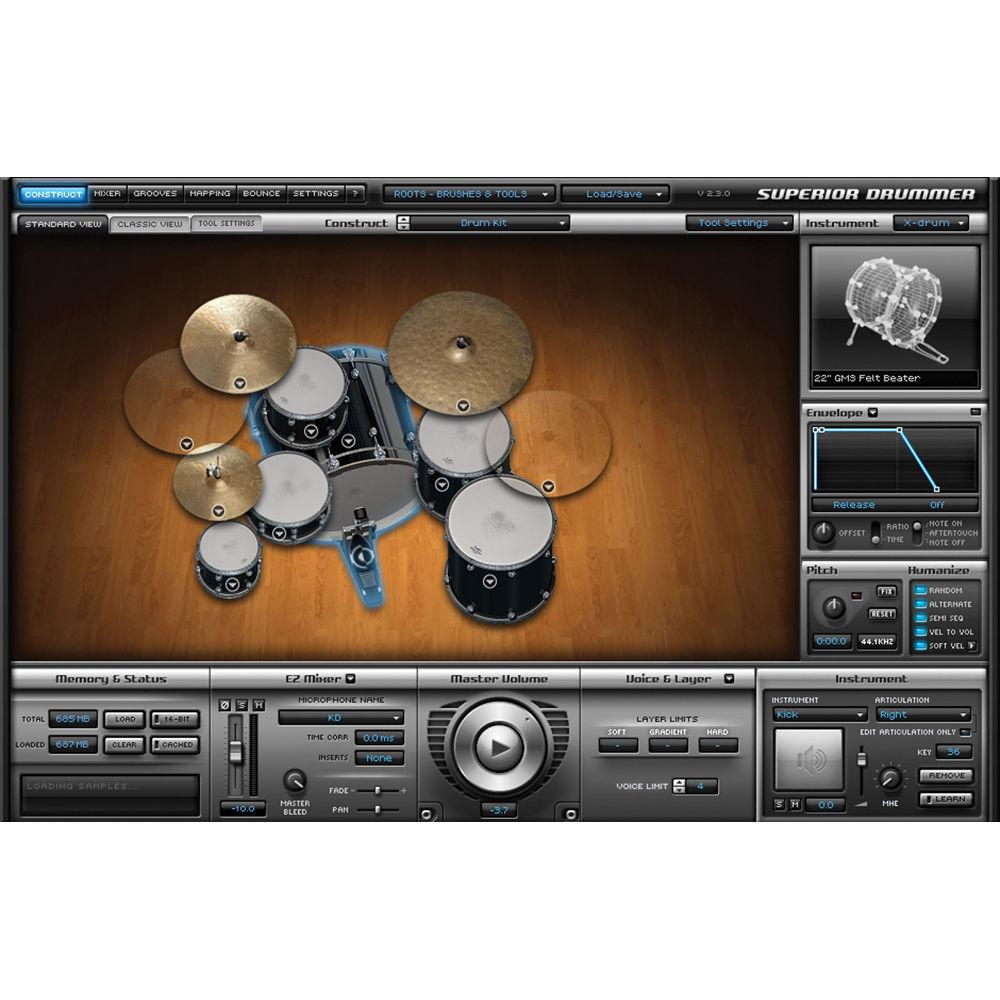
User Manual for Toontrack Roots SDX - Brushes, Rods and Mallets Click to enlarge the picture
 Contents of the user manual for the Toontrack Roots SDX - Brushes, Rods
- Product category: Virtual Instruments Toontrack
- Brand: Toontrack
- Description and content of package
- Technical information and basic settings
- Frequently asked questions – FAQ
- Troubleshooting (does not switch on, does not respond, error message, what do I do if...)
- Authorized service for Toontrack Virtual Instruments

 |
User manual for the Toontrack Roots SDX - Brushes, Rods contain basic instructions
that need to be followed during installation and operation.
Before starting your appliance, the user manual should be read through carefully.
Follow all the safety instructions and warnings, and be guided by the given recommendations.
User manual is an integral part of any Toontrack product,
and if it is sold or transferred, they should be handed over jointly with the product.
Following the instructions for use is an essential prerequisite for protecting
health and property during use, as well as recognition of liability on the part of the manufacturer
for possible defects should you make a warranty claim. Download an official Toontrack user manual in which you will find instructions on how to install, use, maintain and service your product.
And do not forget – unsuitable use of a Toontrack product will considerably shorten its lifespan!
|
Product description Toontrack's Roots SDX - Brushes, Rods and Mallets is a high-quality jazz drum library recorded using Blackbird Studio's stock of 1400 microphones, 35 channels of Pultec EQ, 24 channels of Fairchild compression and hundreds of outboard mic/pre channels, including Telefunken, Neve, API, RCA and Chandler. - Recording Gear
- Console:
Neve 8078 - Originally placed in Motown Studios (LA), then owned by Donald Fagen. The Neve 8078 was the last of the "80 series" hand-wired analogue mixing consoles designed and manufactured by Neve for high-end recording studios during the 1970s. These consoles are considered by many experts to be the Rolls Royce of desks and are highly sought after. Each console took several months to build using over 2,500 hours of highly skilled labour and top quality components. It would now be uneconomic to manufacture such equipment to this standard.
External Pre-Amps:
Shadow Hills Gamma (nickel transformer) - Used on the toms, similar to api,neve style pres, but have variable (nickel, steel), or discrete output tranformers. RCA OP-6 - holy grail tube preamp from the '30s with 95 db of gain
Neumann U47:
Classic tube mic, A pressure gradient-operated mic in which the difference in pressure between two physical points provides the driving force for the diaphragm. Another contributor to the 47's characteristic sound is proximity effect and has an earthshaking boost in the bass region when it's switched to the cardioid, or unidirectional positions.
RCA 44:
Classic ribbon microphone, the natural sound can also be made to sound warm, big, and syrupy (Bing Crosby-like) when placed within two or three feet of the source. Very popular in the 40's-50's as a radio broadcast mic.
NS-10:
Speaker from a Yamaha NS-10 studio monitor flipped out of phase to produce enhanced lower frequencies of kick drums.
Shure SM57:
Industry standard dynamic mic, widely used in studio and in live applications for snare drums, electric guitars, etc...
AKG451:
Identical acoustics to legendary CK 1, precise, nearly frequency independent cardioid, extremely accurate signal transfer and ruler-flat on-axis frequency response.
AKG C12:
The C 12 is a studio condenser microphone of the highest professional quality. The first choice of many studio and engineer for it's flagship microphone. Nine different directional characteristics can be selected by means of a remote control unit without any change in frequency response or sensitivity. In addition to three basic characteristics, omni-directional, cardioid and bi-directional, six intermediate patterns (including hypercardioids) are available.
SAX GML (Sheffield audio labs):
George Massenburg's personal SAX microphones, built using the best components from 8 AKG C12 microphones.
AEA 88:
A newer company that makes close to exact versions of the classic older ribbon mics, this version is used a lot for stereo overheads and piano.
Telefunken 251:
Cool because the serial numbers are so close (almost consecutive) which makes them perfect for a mtached stereo pair, Probably one of the most sought after and really rare for their sonic clarity and detail.
Coles 4038:
Originally used as a broadcast microphone by the BBC, has recently become a standard drum room ribbon mic.
Elam 201:
This is a funky old ribbon microphone that you probably will not see anywhere else these days, it is a 1930's microphone, and really rare. Here is paired with the RCA OP-6 preamp from the '30's w/ 95db of gain! So, a true classic sonic color is added to the sound.
Neumann M50:
Omni-directional tube mic, popular in classical recordings, and using these with decca tree configuration creates a very natural room sound.
Neumann 582:
A very unusual tube microphone, small diaphram, very detailed, used in close to the drummers ears to create the drummers perspective of what he's hearing.
AKG D19:
The classic Beatles mic, dynamic, compresses really, really well, used in a tube hidden in pass through next to the studio room - Cymbal Set
- Position 1: 22" K Zildjian Constantinople Medium
Position 2: Bosphorus Ferit Series
Position 3: 22" K Zildjian Constantinople Light
Position 4: 22" Sabian HHX Manhattan Ride - Hi-Hat
- 14" Masterworks Meritamon Series
- Bass Drums
- 18" Pearl Reference Series with closed heads
22" Gretsch USA Custom Series
22" Ludwig Maple Psychedelic
22" Damped Ludwig Maple Psychedelic
28" Camco - Snare Drums
- Pearl 50th anniversary Solid Maple Shell (#3 of 100 ever made)
- Toms
- 10" Gretsch USA Custom Series
12" & 14" Pearl Reference Series
16" Slingerland Radio king - Acoustic live reverb chamber
- 3 different ambience stereo mic pairs
- 3 different kick drum mics
- 3 different snare drums mics
- Recorded by Roy "Futureman" Wooten in Blackbird Studio Nashville, TN
- Approximately 28 GB of raw, unprocessed sounds
- A total of 23 separately recorded, tweakable channels available in the mixer
- Large selection of different drums and cymbals (Pearl, Gretsch, Ludwig, Zildjian, Paiste)
UPC: 825810001586 Table of Contents
|
Upload User Manual
Have you got an user manual for the Toontrack Roots SDX - Brushes, Rods and Mallets in electronic form? Please send it to us and help us expand our library of instruction manuals.
Thank you, too, on behalf of other users.
To upload the product manual, we first need to check and make sure you are not a robot. After that, your "Submit Link" or "Upload File" will appear.
Technical parametersToontrack TT158SN Specs | Minimum System Requirements (Mac) | Mac OS X 10.5 or higher, 2GHz G5 with 1.5GB RAM (multi-core CPU with 2GB or more recommended)
28 GB free hard disc space (2 GB for basic install), DVD drive, a working Superior Drummer 2.3 installation | | Minimum System Requirements (PC) | Windows XP SP3 or newer, 2GHz Pentium 4 or Athlon with 1.5GB RAM (multi-core CPU with 2GB or more recommended)
28 GB free hard disc space (2 GB for basic install), DVD drive, a working Superior Drummer 2.3 installation |
Rating60% users recommend this product to others. And what about you?

This product has already been rated by 89 owners. Add your rating and experience with the product.
Discussion
 Ask our technicians if you have a problem with your settings,
or if anything is unclear in the user manual you have downloaded.
You can make use of our moderated discussion.
The discussion is public and helps other users of our website who may be encountering similar problems.
Ask our technicians if you have a problem with your settings,
or if anything is unclear in the user manual you have downloaded.
You can make use of our moderated discussion.
The discussion is public and helps other users of our website who may be encountering similar problems.
The discussion is empty - enter the first post
Post a new topic / query / comment:
|
|
|
| Request for user manual |
You can’t find the operation manual you are looking for? Let us know and we will try to add the missing manual:
I’m looking for a manual / Request for manual
Current requests for instruction manuals:
Call Of Duty World War Two For Xbox...
controller stratus XL...
stratus XL...
smart whatch serie S11 42mm...
Allen & Heath SQ-6 manual...
|
| Discussion |
Latest contributions to the discussion:
AEW R 4100
Name: MAURICIO ANGARITA
Audio-Technica AEW-R4100 UHF Diversity Receiver for
AEW R 4100 has the mute function blocked and does not allow audio to pass. I tried several times to turn off the mute from the transmitter but it does nothing, the mute stays on. Solution?
Thank you...
Instructions for assembling the 2015 Forecast Image Master Consoles GC3-A
Name: mike elam
Forecast Consoles GC3-A ImageMaster Editing Console
Looking for instructions for assembling this console. ...
EMPTY TONER ERROR MESSAGE AFTER REPLACING TONER
Name: LINDA BAD YELLOW EYES
Brother TN223BK Standard-Yield Toner
I HAD TO CHANGE OUT ALL THREE TONERS DUE TO LEAKS IN THE YELLOW AND CYAN. AFTER I REPLACED THEM, THE MACHINE KEEPS GIVING ME AN EMPTY TONER ERROR MESSAGE. HELP!!...
PS480D 20/24 pin Switching 480W Power Supply
Name: swkargo
Logisys 480W Power Supply
This item states in can run -5vdc .It is NOT listed on the board or I beleive is r4 is missing the resitior. Any body have thid issue. Shawn
...
Help needed
Name: Ann Carter
SanDisk 1TB Extreme Portable USB 3.1
When I click the link to download the user manual for my Sandisk Extreme external hard drive, it gives me the manual for the LG Cricket. Can you please change the link so I can download the Sandisk manual and begin using this drive? Thank you....
|
|