|
User Manual for TV One Edge Blender Click to enlarge the picture
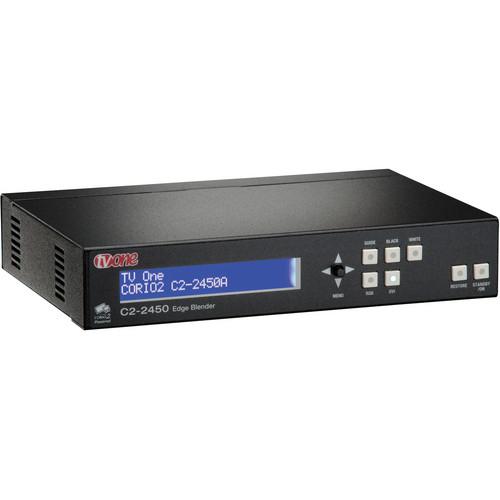 Contents of the user manual for the TV One Edge Blender
- Product category: Video & Audio Processing TV One
- Brand: TV One
- Description and content of package
- Technical information and basic settings
- Frequently asked questions – FAQ
- Troubleshooting (does not switch on, does not respond, error message, what do I do if...)
- Authorized service for TV One Video & Audio Processing
|
User manual for the TV One Edge Blender contain basic instructions
that need to be followed during installation and operation.
Before starting your appliance, the user manual should be read through carefully.
Follow all the safety instructions and warnings, and be guided by the given recommendations.
User manual is an integral part of any TV One product,
and if it is sold or transferred, they should be handed over jointly with the product.
Following the instructions for use is an essential prerequisite for protecting
health and property during use, as well as recognition of liability on the part of the manufacturer
for possible defects should you make a warranty claim. Download an official TV One user manual in which you will find instructions on how to install, use, maintain and service your product.
And do not forget – unsuitable use of a TV One product will considerably shorten its lifespan!
|
Product description The TV One Edge Blender allows you to align multiple projectors in a pixel perfect way for avoiding either a gap between the images or a double bright seam. With pixel-accurate scaling, the edge blender is a smart solution for overlapping 2 or more images to create a seamless transition. It overlaps the images by a significant amount, and modifies the pixels in the region to make the overlap as invisible as possible.
Featuring Automatic Incomming Resolution Detection, the Edge Blender supports a wide range of sources by offering compatibility with analog resolutions up to 2048 x 2048, DVI up to 1920 x 1200, and HDTV up to 1080p. It uses temporal and diagonal interpolation techniques and uses 4:4:4 full bandwidth sampling to further enhance the final output. Via gamma correction, the Edge Blender compensates for the irregularities in brightness of different images to create an optimum blend. It features adjustments for various video signal parameters for making fine adjustments to the picture quality. A variable image zoom allows you to inspect the image very minutely with 10x zoom or get an overview via shrinking of the image to as low as 10%. It provides black and white test outputs for checking the display quality.
With 10 user defined presets, the Edge Blender allows you to customize settings for various applications. Featuring a non-volatile memory, it stores the settings used, thus saves setup time for your next use. In addition, even if the power is turned off, your settings are not lost. Windows control panel software allows you to control your Edge Blender using your PC. You can also control the unit via front panel push buttons, IR, RS-232 signaling, and over an IP network. It also includes a front panel LCD for quickly making the necessary change in settings. - Designed to align multiple projectors in a pixel perfect way for avoiding either a gap between the images or a double bright seam
- Pixel-accurate scaling - for overlapping 2 or more images to create a seamless transition
- Automatic Incoming Resolution Detection
- Supports a wide range of sources by offering compatibility with analog resolutions up to 2048 x 2048, DVI up to 1920 x 1200, and HDTV up to 1080p
- Temporal and diagonal interpolation
- 4:4:4 full bandwidth sampling
- Features adjustments for various video signal parameters for making fine adjustments to the picture quality
- Allows you to inspect the image very minutely with 10x zoom or get an overview via shrinking of the image to as low as 10%
- Black and white test outputs
- 10 user defined presets allow you to customize settings for various applications
- Non-volatile memory - stores settings even in case of no power (saves setup time for your next use)
- Windows control panel software
- CORIOtools Suite compatible
- Control the unit via front panel push buttons, IR, RS-232 signaling, and over an IP network
- Front panel LCD for quickly making the necessary change in settings
- Optional single/dual rackmount kit
In the Box TV One Edge Blender Operations Manual Power Adapter (US, UK, Euro, or AU) 5-Year Parts & Labor Table of Contents
|
Upload User Manual
Have you got an user manual for the TV One Edge Blender in electronic form? Please send it to us and help us expand our library of instruction manuals.
Thank you, too, on behalf of other users.
To upload the product manual, we first need to check and make sure you are not a robot. After that, your "Submit Link" or "Upload File" will appear.
Technical parametersTV One C2-2450A Specs | | | Signal Type | 1 x DVI-D via DVI-I connector / 1 x analog via HD-15 female | | Formats | RGBHV, RGBS, RGsB, YPbPr | | Sync | TTL Level, 10Kohm, pos or neg | | Termination | 75 ohm | | R-G-B Level Range | 0.5 to 2 Vpp | | Scan Rate Detection | Automatic
PC Resolutions
DVI: up to 1920x1200 60Hz
Analog: up to 2048x2048
HDTV Resolutions: Any up to 1080p/60 | | Maximum Horizontal Scan Rate | 150 KHz | | Computer Compatibility | PC, Macintosh, Workstations | | | | Signal Type | 1 x DVI-I via DVI-I connector / 1 x analog via HD-15 connector | | Formats | RGBHV, RGBS, RGsB, YPbPr | | Resolutions | Analog signals: PC to 2048x2048,HD to 1080p/60
DVI signals: PC to 1920 x 1200,HD to 1080p/60 | | R-G-B Level | 0.7 Vpp | | Vertical Refresh Rate | Any to 250 Hz | | | | Size and Position | Automatic via autoset or manual | | Image Size | User-definable presets | | Image Freeze | 1 video frame | | Settings Memory | Non-volatile | | Zoom Range | Variable to 10x Zoom | | Shrink Range | Variable to 10% | | Image Mirroring | Horizontal and/or vertical | | Horizontal Filtering | Full digital | | Conversion Technology Proprietary | CORIO2 | | Frame Rate Conversion | Temporal | | Color Resolution | 24-bit (16.8 million colors) | | Sampling Rate | 162 MHz | | Digital Sampling | 24-bit, 4:4:4 format | | Firmware Memory | flash, upgradeable via RS-232 | | | | Local Control | Via front panel buttons & OSD | | Interface | RS-232: via D9 female connector
IP: via RJ45 connector | | IR Remote | Optional IRC-5 remote unit | | Input Expansion Control | Via D-15 options connector | | Regulatory Compliance | Main Units: FCC, CE, RoHS
Power Supplies: UL, CUL, CE, PSE, GS, RoHS | | | | Operating Temperature | 32 to 122° F (0 to 50° C) | | Operating Humidity | 10 to 85%, non-condensing | | Storage Temperature | 14 to +158° F (-10 to 70° C) | | Storage Humidity | 10 to 85%, non-condensing | | Power Supply | 12 V DC @ 1 A | | | | Dimensions (HxWxD) | 1.63 x 8.6 x 5.9" (41.5 x 218 x 150 mm) | | Weight | 2.90 lb (1.32 kg) | | | | Package Weight | 1.0 lb | | Box Dimensions (LxWxH) | 13.75 x 9.5 x 6.5" |
Rating80% users recommend this product to others. And what about you?

This product has already been rated by 52 owners. Add your rating and experience with the product.
Discussion
 Ask our technicians if you have a problem with your settings,
or if anything is unclear in the user manual you have downloaded.
You can make use of our moderated discussion.
The discussion is public and helps other users of our website who may be encountering similar problems.
Ask our technicians if you have a problem with your settings,
or if anything is unclear in the user manual you have downloaded.
You can make use of our moderated discussion.
The discussion is public and helps other users of our website who may be encountering similar problems.
The discussion is empty - enter the first post
Post a new topic / query / comment:
|
|
|
| Request for user manual |
You can’t find the operation manual you are looking for? Let us know and we will try to add the missing manual:
I’m looking for a manual / Request for manual
Current requests for instruction manuals:
Call Of Duty World War Two For Xbox...
controller stratus XL...
stratus XL...
smart whatch serie S11 42mm...
Allen & Heath SQ-6 manual...
|
| Discussion |
Latest contributions to the discussion:
AEW R 4100
Name: MAURICIO ANGARITA
Audio-Technica AEW-R4100 UHF Diversity Receiver for
AEW R 4100 has the mute function blocked and does not allow audio to pass. I tried several times to turn off the mute from the transmitter but it does nothing, the mute stays on. Solution?
Thank you...
Instructions for assembling the 2015 Forecast Image Master Consoles GC3-A
Name: mike elam
Forecast Consoles GC3-A ImageMaster Editing Console
Looking for instructions for assembling this console. ...
EMPTY TONER ERROR MESSAGE AFTER REPLACING TONER
Name: LINDA BAD YELLOW EYES
Brother TN223BK Standard-Yield Toner
I HAD TO CHANGE OUT ALL THREE TONERS DUE TO LEAKS IN THE YELLOW AND CYAN. AFTER I REPLACED THEM, THE MACHINE KEEPS GIVING ME AN EMPTY TONER ERROR MESSAGE. HELP!!...
PS480D 20/24 pin Switching 480W Power Supply
Name: swkargo
Logisys 480W Power Supply
This item states in can run -5vdc .It is NOT listed on the board or I beleive is r4 is missing the resitior. Any body have thid issue. Shawn
...
Help needed
Name: Ann Carter
SanDisk 1TB Extreme Portable USB 3.1
When I click the link to download the user manual for my Sandisk Extreme external hard drive, it gives me the manual for the LG Cricket. Can you please change the link so I can download the Sandisk manual and begin using this drive? Thank you....
|
|